
アジ研図書館とわたし
「南南格差」研究を支えたアジア経済研究所図書館のコレクション
エワウト・フランケマ、トム・ウェストランド
2026年11月
アジ研図書館への道
2026年2月、私たちは約1カ月間にわたり東京に滞在し、アジア経済研究所図書館(以下、アジ研図書館)に通って調査研究を行った。その目的は、オランダ科学研究機構(NWO)の助成を受けた研究プロジェクト「South-South Divergence(南南格差): 東南アジアとサハラ以南アフリカにおける地域統合・分断の比較史」に関連する研究課題に取り組むためだ。私たちはこのテーマについて4年間にわたり研究を続けている。本研究は、「なぜ東南アジア経済はアフリカ諸国よりもはるかに力強い成長を遂げ、工業化についてもより迅速に進展したのか」という問いを中心に据えている。1950年代から1960年代の貿易、生産、所得に関する集計データをみると、両地域はほぼ同程度の経済水準にあったが、今日、その格差は大きく広がっている。私たちは経済史研究者として、それぞれの地域の歴史を検証することで、グローバルサウスに属するこの2地域間にどのようにして格差が生じたのかを理解できると考えている。
この格差を調査するためには、長期的な経済発展に関する多様な側面について、膨大なデータセットを構築する必要があった。歴史資料を用いることで、両地域間だけでなく、それぞれの地域の国同士を比較することも可能になる。しかし、本プロジェクトで頻繁に利用しているヨーロッパの図書館では、アフリカやアジア諸国の統計資料が十分とはいえない。また、専門図書館でなければそもそも統計年鑑程度しか収集していないことが多く、所蔵にも欠落がある。統計資料は必ずしも十分には目録化されておらず、書庫への立ち入りが認められていない研究者にとってはどの程度の資料が所蔵されているのかを把握することさえ困難なのである。
充実ぶりと使いやすさが魅力のコレクション
そんな私たちにとって、アジ研図書館はあらゆる面でまさに「宝の山」。実用的な観点でいえば、研究者が書架へ直接アクセスできる開架方式が採られているため、アジ研図書館は書架を見て回りながら研究の手がかりを探すような調査に特に適している。経済史研究者は、統計資料を実際に開いてみるまで、どのようなデータが掲載されているのかわからないことが少なくない。こうした刊行物では、予告なく新しいデータの掲載が始まったり、刊行自体が打ち切られたりすることもよくある。そのため、同じ出版物のシリーズ全体を通覧して、利用可能な時系列データを構築できるかどうかを素早く判断できる環境は極めて貴重だ。
さらに、アジ研の蔵書は、私たちが知るヨーロッパのどの図書館と比べてもはるかに充実している。同一の統計資料が数十年分にわたって所蔵されているため、比較的長期のデータ系列を容易に構築できる。また、特にアジア、アフリカ、ラテンアメリカを研究対象とする研究者にとって、その蔵書がカバーする地理的範囲の広さは驚くべきものだ。実際、私たちは書架を閲覧しているだけで、これまでみたことのなかったアフリカの統計資料をいくつも発見した。さらに同図書館は、地方・地域レベルの刊行物や、月次・四半期ごとの統計資料まで幅広く所蔵している。
今回の図書館訪問の成果として、私たちは極めて多様なデータセットを構築することができた。これらは、近くケンブリッジ大学出版局から刊行する予定の新著『South-South Divergence: How Southeast Asia and Tropical Africa Grew Apart Before the Green Revolution(南南格差:なぜ東南アジアと熱帯アフリカは緑の革命以前に異なる発展の道を歩んだのか)』の土台となっている。アジ研図書館の広域にわたる資料収集の蓄積がなければ、これほど多様な統計資料を集めることははるかに困難だっただろう。
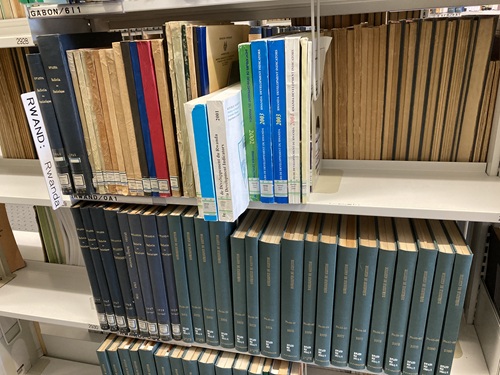
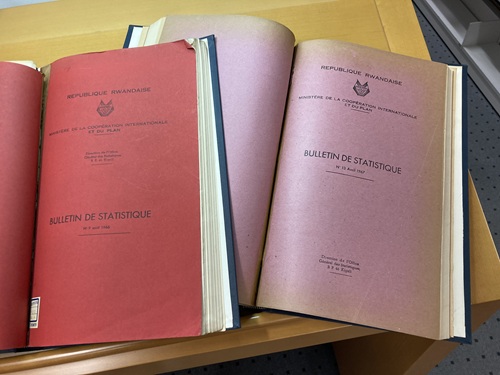
その一例が、1960年代から1980年代にかけてのルワンダの月次食料価格データベースだ。この詳細なデータセットは、アジ研図書館でなければ構築できなかったもののひとつである。私たちはこのデータを他のデータベースと組み合わせることで、ルワンダの首都キガリの都市市場における食料価格が、ジャカルタやマニラといった東南アジアの都市に比べて、はるかに変動が大きく季節性も強かったことを示した。私たちはその理由として、20世紀前半の東南アジアでは地方・国内・域内の食料市場が発達した一方で、サハラ以南アフリカではそのような発展が難しかったことを挙げている。これは、アフリカの輸送コストが高かったことに加え、植民地政府が輸出用食用作物の生産を奨励しなかったことによるものだ。
アジ研図書館は価格データだけでなく、地域間輸出パターン、精米施設、信用供与(融資)の拡大に関する重要な統計情報へのアクセスも可能にしてくれた。これらのデータによって私たちは、東南アジアではコメの国際取引、域内・国内取引が行われていたが、熱帯アフリカにはそれに相当するものがなく、このコメ取引が、小規模工業の発展と農村金融の拡大をもたらす決定的な要因であったと示すことができた。さらに私たちは、こうした要因こそが、その後の東南アジア経済の成長、特に「緑の革命」の到来期における発展を可能にした重要な基盤であったと論じている。アジ研図書館で収集した資料がなければ、この見解をこれほど包括的に実証することはできなかっただろう。
統計資料のその先へ
もちろん、アジ研図書館の価値は統計資料だけにとどまらない。政府報告書をはじめとする一次資料や、豊富な二次文献の所蔵範囲と内容の充実度は、アジアおよび発展途上国の経済発展に関心を持つ研究者にとって理想的な研究環境を提供している。図書館は非常にわかりやすく整理されており、関連資料をみつけるのも容易だ。統計資料の場合と同様に、私たちは書架を閲覧するだけで、存在すら知らなかった文書や研究成果を数多く発見した。また、専門知識を備えた図書館スタッフの皆さんから、常に丁寧で親切かつ献身的なサポートを受けられたことも強調したいと思う。そのおかげで、長期間にわたる研究滞在は非常に有意義で快適なものとなった。
私たちは現在、アジア、アフリカ、ラテンアメリカを研究する他の経済史研究者にも、アジ研図書館の利用を積極的に勧めている。同図書館は、発展途上国における長期的経済成長の研究に関して、世界でも屈指の優れたコレクションを有していると確信している。
(監修:高橋理枝、翻訳:池上健慈)
※この記事の内容および意見は執筆者個人に属し、日本貿易振興機構あるいはアジア経済研究所の公式意見を示すものではありません。
写真の出典
- 写真1:高橋理枝撮影。
- 写真2:高橋理枝撮影。
著者プロフィール
Ewout Frankema ワーヘニンゲン大学経済・環境史研究グループ長、教授。英国経済政策研究センター(CEPR)研究員。著書にSouth-South Divergence. How Southeast Asia and Tropical Africa Grew Apart before the Green Revolution (Co-authored with Tom Westland; Cambridge University Press, 2026), “Africa's Migration Transition: A Long-Run Historical Perspective.” (International Migration Review 2026), and The Routledge Handbook of the Economic History of Colonialism (Co-edited with Tirthankar Roy; Routledge, 2026)などがある。
Tom Westland フローニンゲン大学博士研究員。著書に “Fruits of the Boom: Urban Rents, Cash Crop Growth, and Wages in Dakar, 1914–1960” (European Review of Economic History 30(2), 2026), “What happened to the workshop of West Africa? Resilience and decline of handicraft textiles in colonial northern Nigeria, 1911–52” (Economic History Review 77(4), 2024), and “Spatial inequality in living standards and the urban premium in late colonial French West Africa”(Revista de Historia Industrial 33(92), 2024)などがある。
IDE Library and Me
South-South Divergence and the IDE-JETRO historical collections
Ewout Frankema and Tom Westland
November, 2026
A Research Journey to the IDE-JETRO Library
In February 2026 we made an extended stay of around one month in Tokyo in order to visit and work in the IDE-JETRO library, motivated by our research problem, on which we have been working for four years as part of the project South-South Divergence. Comparative histories of regional (dis)integration in Southeast Asia and Sub-Saharan Africa, funded by the Dutch Research Council (NWO). This research project focuses on the question of why Southeast Asian economies have performed much more strongly, and industrialised much faster, than those of Africa. When we look at aggregate figures of trade, production and income in the 1950s and 1960s, the two regions are more or less equal. However, today the gap is very wide. As economic historians, we believe that the history of each region can help us understand how this divergence between two regions in the global South occurred.
In order to investigate this divergence, we needed to assemble very large datasets on many different dimensions of long-term economic development. Historical sources allow us to compare the two regions, and individual countries within them. However, many libraries in Europe which we frequently visit for this project have only incomplete holdings of statistical series for African and Asian countries. Non-specialist libraries often tend to collect only annual statistical publications, if any, and with many gaps. Statistical volumes are also not always well-catalogued and therefore the full extent of the holdings is unclear to researchers who are not allowed access to the stacks.
An Exceptionally Rich and Accessible Collection
In every respect, the IDE-JETRO library has been a goldmine for us. On a practical level, the fact that the library stacks are open for researchers means that the IDE-JETRO library is very well-suited to exploratory work. Often, economic historians do not know before they open a statistical publication what kinds of data they may find. Publications often begin new kinds of data series, or stop publishing them, without much warning. Therefore, the ability to quickly look through a whole series of the same publication to see if a usable statistical series can be constructed is invaluable.
Moreover, the IDE-JETRO collections are more complete than those of any other library we are familiar with in Europe. It is often possible to construct comparatively long data series with ease, since the library often holds decades’ worth of the same statistical publication. The geographical range of the IDE-JETRO collection is remarkable, particularly for researchers working on Asia, Africa and Latin America. We discovered several African statistical publications that we had not encountered before simply by browsing the shelves. The library’s breadth of holdings also extends to local and regional publications, as well as monthly and quarterly series.
The result of our visit to the library is that we have been able to build an extremely diverse range of datasets that serve as the underpinning of our new short book, South-South Divergence: How Southeast Asia and Tropical Africa Grew Apart Before the Green Revolution, which we will shortly publish with Cambridge University Press. Without the wide geographical coverage of the IDE-JETRO library, we would have found it much more difficult to bring this range of statistical material to the table.
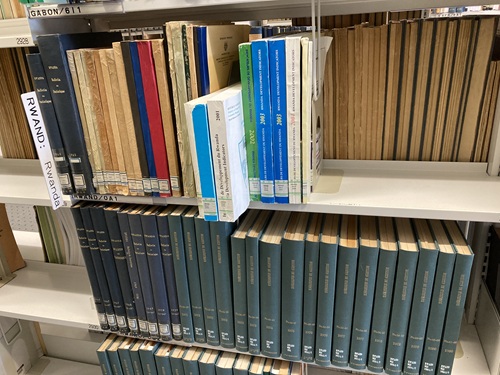
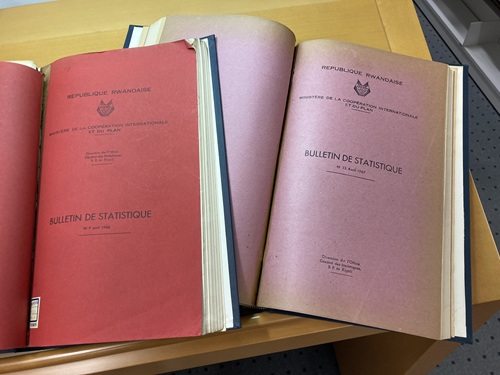
One example of the kind of database that we would have only been able to put together at the IDE-JETRO library is a detailed set of monthly food prices for Rwanda from the 1960s to the 1980s. We use this database, combined with others, to show that prices in urban Kigali were much more volatile and seasonal than those in Southeast Asian cities such as Jakarta or Manila. We argue that this is because in the first half of the twentieth century local, national and regional food markets developed in Southeast Asia in ways that were not possible in Sub-Saharan Africa, both because of higher transport costs in the latter region and the fact that there was no colonial effort to encourage food crops for export.
As well as providing an excellent source of price data, using the IDE-JETRO library also allowed us to access important statistical information on regional export patterns, grain milling facilities, and the expansion of credit. This data helps us to demonstrate our argument that the international, intraregional and domestic rice trades in Southeast Asia, which had no equivalent in Tropical Africa, were the crucial factor in developing small-scale industry and the expansion of rural credit. We argue that these factors were key in enabling later growth in Southeast Asia, particularly at the advent of the Green Revolution. Without the material we gathered at the IDE-JETRO library, we would not have been able to prove this argument as extensively.
Beyond Statistical Collections
Of course, it is not just statistical material that is available at the IDE-JETRO library. The range and depth of the library’s holdings of other primary source material (such as government reports) as well as secondary literature make it an ideal place to work for those interested in economic development in Asia and the developing world. The library is organised very clearly and finding relevant material is very easy. As with the statistical material, we found documents and studies that we otherwise would not have been aware of, simply by browsing the shelves. Moreover, we must also emphasise that the polite, friendly, and always helpful welcome we received from the expert library staff made our extended research stay a pleasant and rewarding one.
We have begun to encourage other economic historians of Asia, Africa and Latin America to consider making use of the IDE-JETRO library, which we firmly believe has one of the best collections in the world for the study of long-run economic growth in the developing world.
Photo credit
- Fig.1: Photo by Rie Takahashi
- Fig.2: Photo by Rie Takahashi
Author Profiles
Ewout Frankema is a professor and chair of the Economic and Environmental History Group of Wageningen University and research fellow of the UK Centre for Economic Policy Research (CEPR). Recent publications include South-South Divergence. How Southeast Asia and Tropical Africa Grew Apart before the Green Revolution (Co-authored with Tom Westland; Cambridge University Press, 2026), “Africa's Migration Transition: A Long-Run Historical Perspective.” (International Migration Review 2026), and The Routledge Handbook of the Economic History of Colonialism (Co-edited with Tirthankar Roy; Routledge, 2026).
Tom Westland is a postdoctoral researcher at University of Groningen. Recent publications include “Fruits of the Boom: Urban Rents, Cash Crop Growth, and Wages in Dakar, 1914–1960” (European Review of Economic History 30(2), 2026), “What happened to the workshop of West Africa? Resilience and decline of handicraft textiles in colonial northern Nigeria, 1911–52” (Economic History Review 77(4), 2024), and “Spatial inequality in living standards and the urban premium in late colonial French West Africa” (Revista de Historia Industrial 33(92), 2024)