

開催報告
[開催報告] IDE Mekong Research & Dialogue Workshop
Challenges for sustainable development in the Mekong region under frequent climate disasters
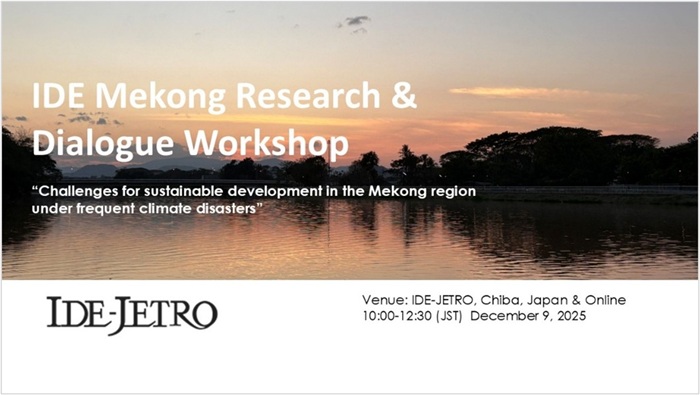
On 9 December 2025, the Institute of Developing Economies (IDE-JETRO) held the Mekong Research & Dialogue Workshop "Challenges for sustainable development in the Mekong Region under frequent climate disasters." Three experts gave presentations on case studies from the Mekong region, followed by a discussion session among panelists, commentators, and other participants.
プレゼンテーションの概要
1. Dr. Thanikun Chantra (School of Social Innovation, Mae Fah Luang University (MFU)):
"Experiences and Challenges in Chiang Rai, Thailand"
- Chiang Rai is Thailand’s northernmost province, bordering Myanmar and Laos. Residents of this area depend on rivers for their livelihoods. Ethnic minority communities living near rivers are particularly vulnerable to climate disasters. Chiang Rai’s location offers economic opportunities but also exposes vulnerabilities to transboundary environmental risks and climate disasters.
- In 2024, the region faced compound disasters including PM2.5 pollution, severe flooding exacerbated by Typhoon Yagi, and river contamination. While contaminated water caused by upstream mining has been monitored by many organizations, concrete solutions remain lacking.
- Resolving transboundary issues requires regional cooperation, including smaller minilateral platforms alongside existing multilateral ones such as the Mekong River Commission (MRC) and Lancang-Mekong Cooperation (LMC) .
- Japan can play a crucial role through its knowledge of the Mekong River, its experience in disaster response, and its collaboration with countries in the Mekong basin.
2. Dr. Kimlong Chheng (Asian Vision Institute (AVI)):
"Experiences and Challenges in Cambodia"
- Cambodia remains vulnerable to natural disasters such as floods and droughts. Although the 2025 floods occurred less frequently than in an average year, they were larger in scale, and their impact extended widely across riverine areas. Regional and international cooperation is needed in data sharing, technology development, and financing.
- Without adequate responses to climate change, Cambodia is projected to face a GDP decline of nearly 10% by 2050, along with more severe floods and droughts and impacts on food security.
- Key challenges include monitoring, financing, early warning systems, and inter-regional and inter-agency coordination—with funding shortages especially urgent. International organizations and donor countries can play a role in addressing these challenges. In addition to funding, technology is also an important driver.
3. Dr. Zhifei Li (National Institute of International Strategy, Chinese Academy of Social Sciences (CASS)):
"Experiences and Challenges in the LMC"
- The Lancang-Mekong Cooperation (LMC) framework addresses increasingly frequent flooding, transboundary risk whereby floods and droughts originating upstream affect downstream areas, and the lack of monitoring and other capacities. China and the five Mekong basin countries have positioned climate change response and basin safety as national development priorities.
- The LMC mechanism follows a "three-in-one" logic comprising: (1) coordination of water resource management, (2) early warning monitoring, and (3) cross-border governance and capacity building. This mechanism is based on the sharing of hydrological and meteorological data, centered on technology empowerment, and underpinned by cross-border cooperation.
- The shared goal of the Lancang-Mekong basin countries is to jointly build a security community. Achieving this requires: (1) adopting "equal consultation and practical efficiency"; (2) hardware/software technical cooperation; (3) strengthening data sharing mechanisms; and (4) mainstreaming livelihood needs.
ディスカッション
- Priorities for balancing resource investment and environmental protection were discussed, with participants noting that both Cambodia and Thailand face challenges in regulating cross-border mining activities.
- Regarding regional mechanisms, the importance of the LMC's role in facilitating dialogue and cooperation on flood pulse management and other issues of mutual interest among downstream countries and the broader region was highlighted.
- It was acknowledged that engagement with Myanmar in regional cooperation remains challenging, although informal information sharing at the local level is gradually improving. It was noted that the LMC platform could help foster information sharing among riparian countries, including Myanmar.
- It was discussed that community participation, based on the principle of equal partnership rather than one-way assistance, is essential. On the other hand, participants cautioned against overwhelming residents with data and noted that relying solely on local input is insufficient without broader institutional support.
開催日時・場所
2025年12月9日(火)10:00-12:30
アジア経済研究所A32会議室+Zoom (ハイブリッド形式)
主催
ジェトロ・アジア経済研究所(IDE-JETRO)
プログラム
アジ研ポリシー・ブリーフ
- Dr. Thanikun Chantra, School of Social Innovation, Mae Fah Luang University (MFU)
“Beyond Dialogue: Closing the Transboundary Governance Gap in the Mekong Region—Lessons from Compounding Crises in Chiang Rai, Thailand “ - Dr. Kimlong Chheng, Asian Vision Institute (AVI)
“Closing Cambodia’s Climate Disaster Preparedness Gap: Early Warning Systems, Climate Financing, and Implementation Challenges”
関連リンク
- [Report] International Symposium Challenges for Sustainable Development in the Mekong Region under Frequent Climate Disasters
- [Report] The 4th Mekong Dialogue “The Water-Food-Energy-Climate Nexus: Revisiting Development in the Mekong Region"
- The Mekong Dialogue: School of Social Innovation, Mae Fah Luang University