


レポート・報告書
アジ研ポリシー・ブリーフ
No.286 Closing Cambodia’s Climate Disaster Preparedness Gap: Early Warning Systems, Climate Financing, and Implementation Challenges
CHHENG Kimlong
PDF (296KB)
- Cambodia should strengthen local community awareness and participation by enhancing its early warning system through data sharing and timely reporting.
- Cambodia should address gaps in climate and disaster response financing by increasing public investment and mobilizing external funding sources.
- Cambodia should improve the effectiveness of policy planning and intervention by strengthening both technical and scientific capacities and enhancing cross-ministerial institutional arrangements.
Introduction
Cambodia’s ongoing susceptibility to severe floods, intense droughts, and volatile weather patterns poses risks to its economic growth, socioeconomic livelihoods, and food and human security. With approximately 80% of its population residing in rural, climate-sensitive areas and approximately 65% depending on agriculture, timely warnings of floods, droughts, and storms are critical for food security (WFP 2025).
The country’s exposure to climate-related hazards is extensive and interconnected. According to the National Disaster Management Committee (NCDM), floods annually affect about 3.5 million Cambodians, or 21% of the population, whereas droughts impact roughly 5.2 million, or 31% of the population. Additionally, NCDM (2025) identified storms as one of the country’s primary natural hazards. Without proper adaptation and mitigation measures, climate change will amplify the frequency, intensity, and severity of these disasters. Climate change is estimated to cost up to 9% of Cambodia’s GDP by 2050 and to raise the poverty rate by up to 6% points by 2040.
However, Cambodia’s climate financing and early warning systems (EWS) remain underdeveloped and poorly implemented due to insufficient funding and weak institutions. Moving forward, the country must actively resolve critical gaps across three interconnected areas: EWS (Section 1), climate financing (Section 2), and implementation capacity and governance (Section 3). These gaps correspond to five specific focus areas, with their respective priorities and expected outcomes summarized in Table 1.
Digital Adoption and Inclusivity in the EWS
Adopting an advanced EWS can help Cambodia strengthen its capacity to plan and respond effectively to natural disasters. The country’s climate disaster preparedness is currently undergoing a significant transitioning, marked by the endorsement of the National Roadmap for Early Warnings for All (EW4ALL 2025–2028) and the launch of the Cambodia Climate Change Strategic Plan (CCCSP 2024–2033). In line with the priorities of the Association of Southeast Asian Nations and its development partners, the EW4ALL 2025–2028 roadmap aims to enhance multi-hazard monitoring, strengthen warning communication systems, and ensure the timely delivery of emergency information to risk-prone regions to protect vulnerable sectors, including agriculture and urban infrastructure (CME 2025).
Closing the Climate Financing Gap
Cambodia’s climate financing relies on international sources, including the Green Climate Fund, the Global Environment Facility, and the Climate Risk and Early Warning Systems Initiative, and domestic budget allocations. For the National Roadmap, the country faces a US$22.7 million shortfall, equivalent to 41% of the total estimated cost (WFP 2025). Over the next decade, Cambodia will need an estimated US$32.2 billion to accelerate green investments, reduce greenhouse gas emissions by up to 55% by 2035, and implement climate adaptation, mitigation, and enabling measures. Given limited public funding, Cambodia is expected to mobilize approximately US$22.5 billion, or 70% of the total roadmap costs, from international sources to bridge this gap.
Cambodia should shift its focus from reactive emergency response spending to proactive, long-term disaster risk financing. However, three funding barriers hinder this transition. First, fragmented climate finance complicates government coordination and weakens national ownership. Second, eligibility requirements for external funding can delay disbursement and must align with domestic procedures, including the National Budget Law and subnational adaptation funds. Third, the country lacks public post-disaster insurance and risk transfer mechanisms, leaving communities exposed to high relief and recovery costs (ADB 2024).
Implementation Challenges
There are five structural challenges to implementing the CCCSP 2024–2033. First, system reliability is compromised by inadequate infrastructure connectivity and insufficient funding for operation and maintenance. Second, limited scientific capacity and location-specific data constrain comprehensive risk assessment and long-term planning, reducing the effectiveness of anticipatory EWS. Third, financing remains insufficient. Although implementation depends on public funding, early warning data are not integrated with risk financing mechanisms, thereby limiting timely action. Fourth, designing an inclusive system remains a challenge, particularly in reaching and engaging remote communities. Fifth, implementation is hindered by the absence of a whole-of-government coordination mechanism. Without a mandated cross-ministerial mechanism that defines stakeholder roles and responsibilities, coordination between national agencies and provincial working groups remains fragmented (NCDM 2025). Effective coordination requires clear communication and accountability across line ministries and local authorities.
Conclusion and Ways Forward
Bridging Cambodia’s climate disaster preparedness gap requires a shift from fragmented, reactive interventions to an integrated and anticipatory approach. To successfully translate climate resilience objectives into measurable outcomes, the country must establish stronger institutions, secure sustainable financing, and implement effective coordination across all levels of government and relevant stakeholders.
Table 1. Priorities and expected outcomes across the five key areas
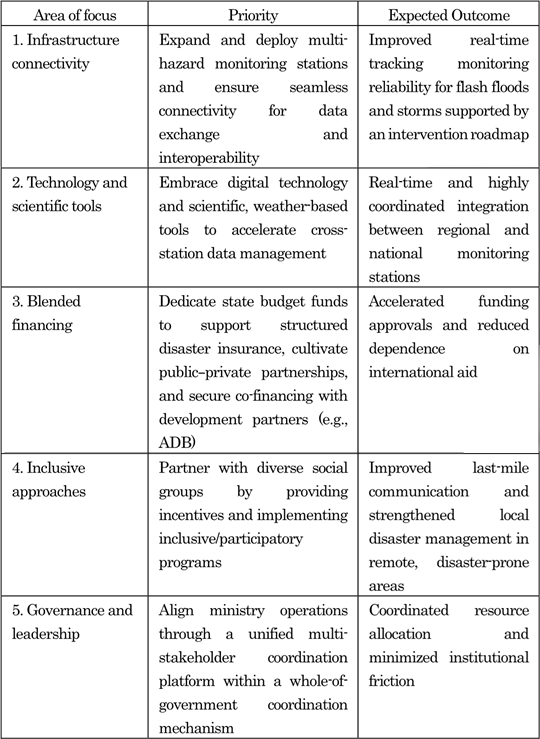
(Adapted by the Author 2026)
(CHHENG Kimlong, Asian Vision Institute)
References
- Asian Development Bank (ADB). 2024. The Enabling Environment for Disaster Risk Financing in Cambodia: Country Diagnostics Assessment.
- Cambodia’s Ministry of Environment (CME). 2025. Cambodia’s Third Nationally Determined Contribution (NDC 3.0).
- National Committee for Disaster Management (NCDM). 2025. Cambodia’s National Roadmap for Early Warnings for All (EW4ALL 2025–2028).
- UN World Food Program (WFP). 2025. Cambodia Launches National Roadmap to Save Lives with People-centred Early Warning Systems.
The views expressed in the document are those of the author(s) and neither the Institute of Developing Economies nor the Japan External Trade Organization bears responsibility for them. ©2026 Author(s)