

IDE Research Columns
Column
China’s Wildlife Regulations After COVID-19: Why Was “One Health” Approach Weakened?
Kenji OTSUKA
Institute of Developing Economies, JETRO
July 2026
This study examines China’s wildlife governance in the aftermath of COVID-19. In response to the pandemic, China undertook several legal reforms to strengthen public health regulation, which partially incorporated the One Health approach—the idea that human, animal, and environmental health are deeply interconnected. However, significant enforcement challenges persist. China’s wildlife industry is extensive and therefore resistant to tighter controls. Furthermore, international pressures surrounding debates over the origins of COVID-19 contributed to a gradual erosion of regulatory momentum.
One Health and Wildlife Governance in China
The COVID-19 pandemic has had far-reaching effects on medicine, politics, the economy, and society worldwide. At its root lies the ecological challenge of coexistence among species, including humans and nonhumans, which has created various problems within the global expansion of socioeconomic systems. The global spread of zoonotic diseases, such as COVID‑19, has reminded global health researchers that human health is interconnected with animal health and ecosystems, and has drawn increasing attention to the “One Health” approach proposed by global health researchers and their collaborators, which integrates the health of humans, animals, and the environment (Amuasi et al. 2020). However, the implementation of such an approach in policy practice remains challenging.
My book chapter (Otsuka 2025) examines China’s response to the tensions arising from interactions among humans and nonhuman animals that long shaped Chinese policy thinking within the One Health perspective.
Wildlife management, especially management of wild animals, is a cross-sector issue encompassing nature conservation, agriculture, food safety, and human and animal health. One would reasonably assume that COVID-19, an emerging zoonotic disease, would affect wildlife management in any part of the world, particularly in China, where the initial outbreak occurred in Wuhan.
A key moment in the Chinese government’s response to COVID-19 was its crackdown on illegal wildlife trade and dietary practices, adopted in February 2020, at a time when the outbreak was suspected to have originated from the country’s thriving wildlife trade and consumption practices, similar to the severe acute respiratory syndrome (SARS) outbreak in 2003. Therefore, relevant actions were undertaken by governmental organizations, researchers, and environmental protection groups across the health, environment, agriculture, and distribution sectors. This momentum led to the amendment of the Wildlife Protection Law, which was adopted in December 2022 and became effective in May 2023. The amendment process generated significant debate among nongovernment organizations and experts over a critical issue central to the One Health approach: how to balance the use of wildlife with the need to protect it.
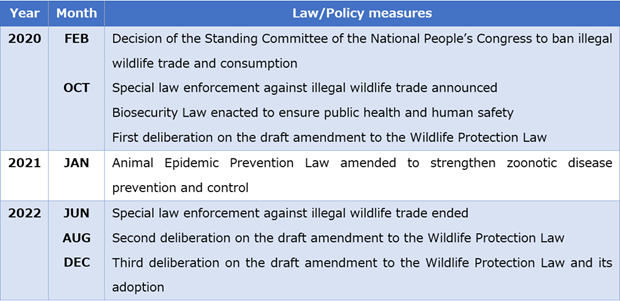
Table 1. Policy Developments on Wildlife Use and Regulation in China Since the COVID-19 Pandemic
Source: Compiled by the author.
Strict Measures with Loopholes
When the COVID-19 pandemic began, public sentiment demanded a total ban on the consumption of all terrestrial wildlife, which was based on the premise that virus spillover from wildlife to humans—identified by the World Health Organization–China joint investigation team as a possible transmission pathway—mirrored the cause of SARS. The government responded with several legal measures addressing zoonotic diseases—and, for the first time since SARS, a wildlife consumption ban was introduced, albeit limited in scope. This suggests that the One Health approach was partially incorporated into the legal framework.
Concurrently, the revision process relaxed regulations governing captive-bred and farmed wildlife—a gap that raised concerns about the ability to prevent and control future infectious disease risks.
Economic Interests and Enforcement Gaps
While legal measures incorporated the One Health approach to some degree, notable exceptions were maintained for wildlife use, raising doubts regarding the effectiveness of monitoring and enforcement. For instance, although certain species were explicitly banned for food consumption, regulations on artificial breeding and captivity were relaxed, shifting from a permit system to a simpler notification system. This change risked encouraging artificial breeding and captivity and, more worryingly, the diversion of animals raised for nonfood purposes—such as traditional medicinal use—into the food supply (ACTAsia, April 28, 2023).
The problem ran deeper than food consumption. An investigation of 72 pharmaceutical companies found that parts of nationally protected animals, such as leopards and pangolins were used in at least 88 traditional Chinese medicine products (Reuters, October 23, 2023). Although the law generally prohibits the sale of nationally protected wildlife, exceptions are allowed for “special circumstances,” such as scientific research, artificial and captive breeding, exhibition, cultural relic protection, and others. Enforcement was also weak. Despite a requirement for wildlife protection labels on packaging since 2008, only 9% of online advertisements were found to display them (Yuhan 2023).
This situation stems from the sectors and regions in China in which wildlife use is a primary industry, alongside a long history of consuming wildlife not only for food but also for medicine. As of 2016, China’s wildlife-related industries employed more than 14 million people and generated a production value exceeding 520 billion yuan (World Bank and FAO, 2022: 69). Predominant among these are the fur, food, and medicine industries. Wildlife-related industries are also particularly significant as a major income source for people in inland regions. It is easy to see how such an enormous economic demand discourages strict regulation.
Social and International Constraints on the One Health Approach
Moreover, the enforcement of the wildlife trade ban effectively ended in June 2022, half a year before the law was even amended. As Chinese society moved past the peak of the pandemic, the motivation to implement a robust One Health approach diminished, which is a factor contributing to the shift from stricter wildlife regulation to a more moderate legal approach.
Furthermore, China—widely identified as the origin of COVID-19 outbreak—faced mounting international pressure, particularly from the United States, regarding responsibility for the pandemic. As doubts were raised about its willingness to cooperate with investigations into the source of the outbreak, China began denying the domestic-origin theory in diplomatic forums. Consequently, calls for stringent regulation of the domestic wildlife trade, which had initially surged within China, gradually faded. This dynamic is also thought to have had a noticeable influence on the amendment of the law.
Based on China’s experience, putting the One Health approach into practice is far from simple. To prevent zoonotic diseases and promote coexistence between humans and wildlife, a complex web of social, economic, and political pressures, both domestic and international, must be navigated and untangled.
Author’s Note
This column is based on the author’s Japanese book chapter below.
Otsuka, Kenji. 2025. “Challenges for the One Health Approach in China's Evolving Wildlife Policy: Debates over COVID-19 Origins and Policy Responses.” In Kenji Otsuka ed., One Health in Asia: Risks and Governance for the Health of Humans, Animals, and the Environment. Chiba: IDE-JETRO.
About the Author
Kenji Otsuka holds a PhD in environmental studies and is the director-general of the Inter-disciplinary Studies Center at the Institute of Developing Economies, Japan External Trade Organization (IDE-JETRO). Since joining the IDE in 1993, he has conducted international collaborative research on environmental governance in China and the broader East Asian region. His research focuses on ecological crises with profound impacts at the local, regional, and global levels, including the COVID-19 pandemic, climate disasters, and transboundary pollution. He published a research article titled “Co-optation in Co-production: Maintaining Credibility and Legitimacy in Transboundary Environmental Governance in East Asia.” Review of Policy Research 39(6), 2022: 771-797. He is also the editor of Interactive Approaches to Water Governance in Asia (Singapore: Springer, 2019).
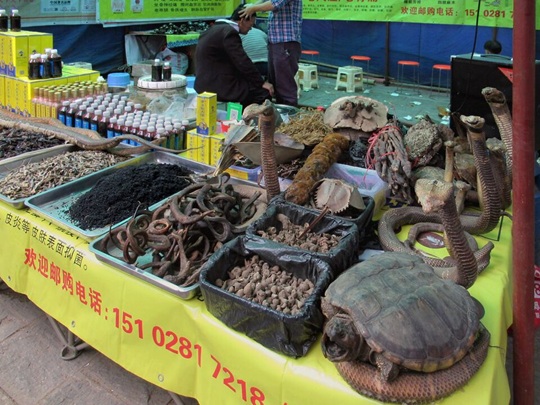
*Thumbnail photo: Animal parts (including from endangered species) go into the Chinese medicines sold at this market stall in Dali, Yunnan, China. David Stanley from Nanaimo, Canada, CC BY 2.0, via Wikimedia Commons.
**The views expressed in the columns are those of the author(s) and do not represent the views of IDE or the institutions to which the authors are attached.
©2026 Kenji OTSUKA

This column is licensed under a Creative Commons Attribution 4.0 International license (CC BY 4.0).
https://creativecommons.org/licenses/by/4.0/deed
Subscribe Stay updated with our latest columns!