
IDE Research Columns
Column
Can Climate-Smart Agriculture Increase Rice Productivity?
Masanori MATSUURA
Institute of Developing Economies, JETRO
September 2026
Climate change is hindering rice farming in Vietnam. Rising temperatures, floods, droughts, and saltwater intrusion threaten the livelihoods of millions of rice farmers and the country's food security. Which agricultural practices can help farmers adapt to these growing challenges? This column introduces findings from our recent study on climate-smart agriculture conducted in the Red River Delta and Central Vietnam. We show that while some practices increase productivity, others mainly help reduce the risk of severe crop losses. Most importantly, what works best depends on when and where rice is grown.
Rice Production in Vietnam Under Climate Threat
Vietnam is ranked among the countries most vulnerable to climate change. Its extensive coastline, deltas, and reliance on agriculture make it particularly susceptible to environmental shifts. Climate change imposes several risks for agriculture. These include extreme heat, salinity, drought, floods, and storms. Standardized rainfall index and annual average temperature of Vietnam from 1901 to 2024 are summarized in Figure 1. It presents greater rainfall variability and an increase in temperatures, indicating enhanced climate risks in recent decades.
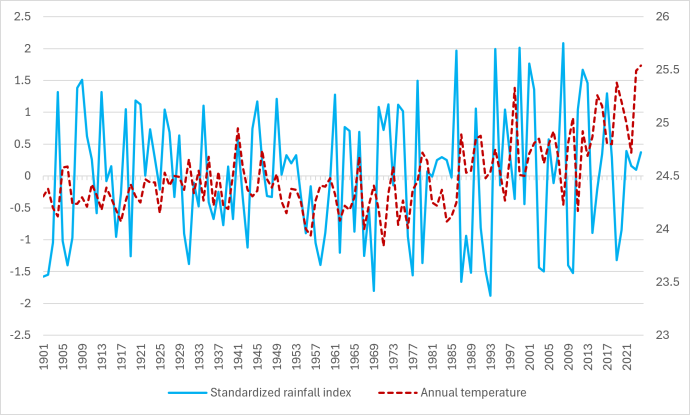
Figure 1. Standardized Rainfall Index and Annual Average Temperature 1901-2024
Note: The standardized index represents the value minus the mean divided by the standard deviation.
Source: Authors’ design based on the World Bank Climate Change Knowledge Portal.
Rice farming in Vietnam is threatened by heatwaves, droughts, floods, and saltwater intrusion. Farmers need to urgently adapt to climate risks; otherwise, rice yields may decline or stagnate over the coming decades.
Therefore, helping farmers adapt to climate change has become essential for sustaining rice production. Our recent study (Kodama et al., 2025) examined the association between adaptation strategies and rice productivity and risk of severe crop losses in the Red River Delta and Central Vietnam—two crucial but understudied rice-producing regions compared to the Mekong Delta.
How Are Farmers Adapting?
In our study, we focused on three commonly used farming practices that help farmers cope with climate change.
- Stress-tolerant varieties: Planting rice varieties that withstand severe environmental conditions, such as floods, heat, or salinity.
- Improved cropping systems: Shifting planting dates or adjusting the cropping calendar to avoid the worst of seasonal climate shocks.
- Pest and disease management: Enhancing pesticide use and crop management to combat the rising threat of pest invasions driven by warmer and wetter conditions.
We analyzed data from 225 and 213 farm households in Central Vietnam (CVN) and the Red River Delta (RRD), respectively, evaluating whether these strategies improved farmers’ rice productivity and reduced the risk of severe crop losses. The survey was conducted in 2016 by the International Rice Research Institute in collaboration with Vietnamese research institutions. Farm households were located in Thái Bình Province (RRD), Nam Định Province (RRD), Quảng Ngãi Province (CVN) and Hà Tĩnh Province (CVN).
Which Strategies Can Increase Rice Productivity and Reduce the Risk of Severe Crop Losses?
Our findings show that different farming practices serve varied purposes. Stress-tolerant rice varieties and improved cropping systems help farmers increase yield. In contrast, enhanced pest and disease management does not significantly elevate average productivity, but it helps farmers avoid severe crop losses during unfavorable years.
Our study also found heterogeneous relationships between adaptation strategies and agricultural outcomes across regions and seasons. In the RRD, characterized by flat alluvial plains and monoculture rice systems, stress-tolerant varieties improve productivity.
Moreover, such varieties enhance productivity during the rainy season, while alterations in cropping patterns increase it during the dry season. Although we found that pest and disease management techniques mitigate production risk, we did not find any heterogeneous association between pest or disease management and production risk across regions and seasons.
Key Takeaways
Climate change causes frequent extreme weather events affecting agricultural productivity. Our findings further encourage adoption of climate-smart agriculture in Vietnam to address threats from climate change. According to the World Bank (2019), the RRD has a high adoption rate of flood-tolerant rice varieties (> 60%), while that of pest management practices remains relatively low (< 30%). Our estimates indicate that pest and disease management can reduce the risk of severe crop loss. The results suggest enhanced benefits from the implementation of pest and disease management policies. To achieve better climate resilience in Vietnamese agriculture, we need further research on how to broadly disseminate climate-smart agriculture and increase its adoption by farmers.
Author’s Note
The main research on which this column is based is: Kodama, Wataru, Masanori Matsuura, and Valerien O. Pede. 2025. "Revisiting the Effects of Climate-Smart Agriculture: A Case of Vietnamese Rice Farmers." World Development Sustainability 7: 100242.
References
World Bank. 2019. “Climate-Smart Agriculture in Viet Nam”. Climate Change Knowledge Portal For Development Practitioners and Policy Makers.
Author’s Profile
Masanori Matsuura is a research fellow at the Institute of Developing Economies. His research interests lie in agricultural, development, and environmental economics. His work has been published in journals such as Food Policy and Agricultural Economics, among others.
Other Articles by This Author
- Kishida, Takaaki, Masanori Matsuura, and Abu Hayat Md. Saiful Islam. 2026. “Unequal Starts: Intrahousehold Child Nutrition Inequality in Bangladesh.” Asian Development Review 43 (2): 275-309.
- Homma, Kirara, Abu Hayat Md. Saiful Islam, Masanori Matsuura, and Bethelhem Legesse Debela. 2025. “Weather Shocks and Child Nutritional Status in Rural Bangladesh: Does Labor Allocation Have a Role to Play?” Food Policy 135, 101918.
- Matsuura, Masanori, Abu Hayat Md. Saiful Islam, and Salauddin Tauseef. 2024. “Mobile Phones, Income Diversification, and Poverty Reduction in Rural Bangladesh.” Review of Development Economics 28 (4): 1475-1493.
- Matsuura, Masanori, Yir-Hueih Luh, and Abu Hayat Md. Saiful Islam. 2023. “Weather Shocks, Livelihood Diversification, and Household Food Security: Empirical Evidence from Rural Bangladesh.” Agricultural Economics 54 (4): 455-470.
*The views expressed in the columns are those of the author(s) and do not represent the views of IDE or the institutions with which the authors are affiliated.
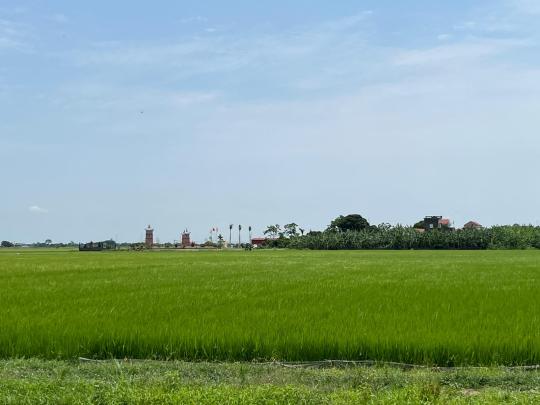
**Thumbnail image: Rice field in Vu Ban, Ninh Binh, Vietnam. Photo credit: Trinh Thi Chung.
©2026 Masanori Matsuura

This column is licensed under a Creative Commons Attribution 4.0 International license (CC BY 4.0).
https://creativecommons.org/licenses/by/4.0/deed
Subscribe Stay updated with our latest columns!