
IDE Research Columns
Column
Why Do Refugees Move to Some Countries but Not Others?
Political Regimes and the Uneven Geography of Global Protection
Masaaki HIGASHIJIMA and Yujin WOO
University of Tokyo; Hitotsubashi University
June 2026
In recent decades, the global number of refugees has reached record highs. While public debate in advanced democracies often focuses on the increasing visibility of refugees at their borders, the majority are hosted not in the Global North but in the Global South. Yet, even within the Global South, the distribution of refugee arrivals is strikingly uneven. Some countries receive vast numbers of refugees, whereas others host very few, despite facing similar geographic or economic conditions. What explains this variation? What does it reveal about the political foundations of refugee protection?
Our Focus
In our article (Higashijima and Woo 2024), we analyze this puzzle by focusing on a factor long underappreciated in debates on forced migration: the domestic political institutions of receiving states. While existing studies emphasize the regime type of origin countries to explain why individuals leave, we shift attention to the regime type of receiving countries to account for migrants' destination selection. We argue that refugee movements are shaped not only by violence and hardship in origin countries but also by the political regimes of potential host countries, which create incentives for both refugees and host governments. Understanding these incentives helps explain why refugee inflows concentrate in certain countries—particularly hybrid regimes that are neither fully democratic nor fully autocratic.
While those fleeing conflict or persecution are often broadly labeled "refugees," this term has a precise legal meaning distinct from related categories. Refugees are formally recognized by a host state; asylum seekers have pending claims; and displaced persons may lack formal status. Our research adopts an inclusive definition of refugees that encompasses asylum seekers and displaced persons, focusing on cross-border populations irrespective of their formal legal recognition.1
Political Regime Type as a Global Sorting Mechanism
At first glance, one might expect refugees to prefer democratic countries, which typically guarantee higher levels of human rights protection, civil liberties, and due process. Indeed, there is strong evidence that asylum seekers consciously seek safety, equality, and predictable treatment upon arrival—conditions more likely to be found in democracies than in autocracies. This "pull" factor is grounded in a rational assessment of the risks and opportunities involved in rebuilding a life away from home.
At the same time, democratic governments face powerful "push-back" dynamics stemming from their democratic features and constraints. Because democratic leaders must respond to public opinion and electoral incentives, they often adopt restrictive entry policies when voters express concerns about migration. Arrivals of forced migrants are often perceived as political or economic threats, and elected leaders risk electoral backlash if they appear too welcoming.
Autocrats face different incentives. Unconstrained by free and fair elections, they are less pressured to respond to public anxieties regarding migration. Some autocracies even find it advantageous to admit refugees, especially when doing so expands access to foreign aid or satisfies labor needs. For instance, Iran, a theocratic authoritarian regime, has long hosted a large number of refugees from Afghanistan, particularly since the Soviet invasion in 1979 and subsequent conflicts. While the Iranian government initially adopted an "open-door" policy grounded in Islamic solidarity, Afghan migrants were systematically incorporated into low-wage sectors (such as agriculture and construction)—suggesting an implicit economic logic underpinning refugee inclusion (Abbasi-Shavazi et al. 2005). However, displaced persons are often unwilling to risk living under a repressive regime where postentry treatment is unpredictable or dangerous.
These opposing tendencies lead to a particular equilibrium: both highly democratic and highly autocratic states tend to receive relatively few refugees. In our article, we formalize this logic and demonstrate it using a global dataset (1951–2016). The results reveal an inverted U-shaped relationship: refugee arrivals are lowest in closed autocracies and consolidated democracies, and highest in the middle of the political spectrum, in countries often labeled "anocracies" or hybrid regimes (Figure 1).
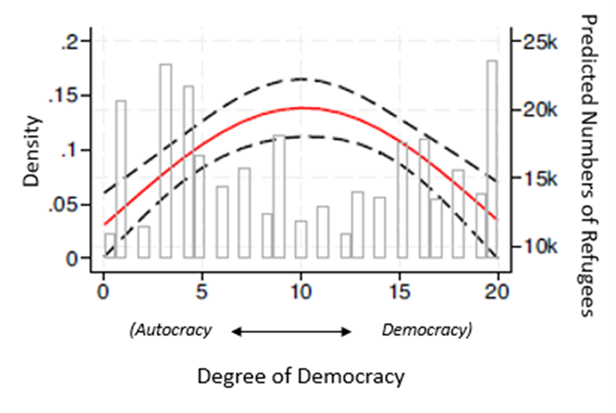
Figure 1. Inverted U-shaped Relationship Between Host Countries' Political Regimes and Refugee Inflows
Note: Political regimes of host countries are measured using the Polity V score (Marshall and Gurr 2020). The solid line indicates the predicted number of refugees, while the dashed lines represent 95% confidence intervals. The bars show the distribution of the Polity V scores. The analysis relies on dyadic data, which record refugee inflows from each origin country to each potential host country as separate country–country pairs.
Source: The graph is based on Higashijima and Woo (2024).
Hybrid regimes attract more refugees for two reasons. First, they are less repressive than autocracies, making them relatively safer destinations from the viewpoint of forced migrants. Second, their leaders are less constrained by public opinion, allowing them to keep borders relatively open. Many hybrid regimes also seek international legitimacy and therefore adopt more welcoming stances toward refugees.
The case of Sudan illustrates these theoretical mechanisms (Higashijima and Woo 2024: 5). Sudan has functioned as both a major source country due to prolonged civil conflicts and a significant host country for displaced populations from neighboring states. Despite poor economic conditions and weak ethnic ties with incoming refugees, it hosts a large number of displaced persons, averaging around 390,000 annually. This pattern reflects Sudan's anocratic characteristics; as a hybrid regime, Sudan is not fully constrained by democratic accountability, enabling relatively open entry policies, yet it lacks the high repression characteristic of closed autocracies. This combination renders it a viable, if suboptimal, destination for displaced populations. While refugee inflows largely originate from more repressive neighboring states, Sudanese refugees tend to move onward toward more stable destinations. Crucially, Sudan combines permissive entry with limited postentry rights. While adhering to nonrefoulement, refugees remain marginalized with restricted opportunities. This aligns with our expectation that anocracies attract refugees by offering safety without the institutional guarantees found in democracies.
What Happens After Refugees Are Officially Accepted?
Our article focuses on refugee inflows, but entry is only the first step. What rights do refugees actually enjoy once inside the host country? How does regime type affect these postentry rights?
These questions are explored in a separate project, including our recent working paper (Higashijima and Woo 2025). Drawing on the newly released Developing World Refugee and Asylum Policy dataset, we analyze cross-national variation in legal protections for refugees upon arrival. The results clarify our second, equally important aspect of the politics of forced migration: democratic states tend to restrict entry but grant more generous rights after arrival, while autocracies often do the opposite.
Democracies generally provide stronger legal protections, broader access to services such as education and health care, and more secure livelihood opportunities. However, they often impose stricter movement restrictions and rarely extend political rights to refugees, reflecting a balance between humanitarian commitments and electoral caution.
This "democratic dilemma" —restrictive at the border but protective within—mirrors the tension between normative values and political risks. It also helps explain why many displaced persons seek entry into democratic states despite the low probability of approval: once accepted, their rights and opportunities are significantly greater.
Beyond Domestic Politics: The Role of International Institutions
A growing frontier of our research examines the role of international organizations—particularly the United Nations High Commissioner for Refugees (UNHCR)—in shaping states' refugee policies. Many developing countries rely heavily on the UNHCR for funding, capacity-building, and legal expertise. However, accepting UNHCR involvement also entails increased international scrutiny and, at times, relinquishing discretionary control over refugee governance.
Given the importance of international initiatives, we also investigate how host states with varying degrees of political openness decide whether to welcome or resist UNHCR engagement, and how these decisions affect refugee rights and long-term international cooperation. We plan to conduct archival and text-analytic research to highlight the important role of host countries' political regimes: more liberal states are more likely to accept the UNHCR's presence, while more authoritarian governments often resist it unless significant material incentives are offered.
Understanding this three-way relationship—among refugees, host states, and international institutions—is essential for designing global responses to forced displacement in an era of rising geopolitical instability.
Toward a More Comprehensive Politics of Refugee Protection
Refugee movements are not random; they reflect systematic patterns shaped by the political institutions of receiving states. Hybrid regimes receive the largest numbers of refugees because they lie at the intersection of two powerful forces: displaced persons' desire for safety and host governments' incentives to maintain flexible, internationally visible refugee policies. Democracies, meanwhile, navigate their own internal dilemma—restricting entry to manage public concerns while providing comparatively generous rights to those who arrive.
As global displacement continues to grow, research on these political dynamics is more urgent than ever. Understanding how forced migrants select destinations, how governments weigh domestic and international pressures, and how international organizations shape outcomes can inform more effective policy responses. Our ongoing research—which combines survey experiments, case studies, global data analysis, and a quantitative textual approach—aims to contribute to this goal and deepen our understanding of refugee protection in an increasingly unstable world.
Authors' Note
This column is based on Higashijima, Masaaki, and Yujin Woo. 2024. "Political Regimes and Refugee Entries: The Preferences and Decisions of Displaced Persons and Host Governments." International Studies Quarterly 68(2): sqae077.
Note
- Our conception of refugees follows the United Nations High Commissioner for Refugees (UNHCR). Since 2007, UNHCR has expanded its terminology to include displaced individuals in 'refugee-like situations' (UNHCR 2015). We therefore adopt this inclusive approach while distinguishing subcategories as needed.
References
Abbasi-Shavazi, Mohammad Jalal, Diana Glazebrook, Gholamreza Jamshidiha, Hossein Mahmoudian, and Rasoul Sadeghi. 2005. "Return to Afghanistan? A Study of Afghans Living in Tehran." Kabul: Afghanistan Research and Evaluation Unit.
Higashijima, Masaaki, and Yujin Woo. 2024. "Political Regimes and Refugee Entries: The Preferences and Decisions of Displaced Persons and Host Governments." International Studies Quarterly 68(2): sqae077.
Higashijima, Masaaki, and Yujin Woo. 2025. "The Democratic Dilemma in Protecting Others: How Political Regimes Shape Post-Entry Rights for Asylum Seekers." Conference paper presented at the Danish Political Science Association (November 2025).
Marshall, M. G., and T. R. Gurr. 2020. Polity V: Political Regime Characteristics and Transitions, 1800–2018. Fairfax, VA: Center for Systemic Peace.
UNHCR. 2015. Statistical Yearbook 2014. Geneva: UNHCR.
Authors' Profile
Masaaki Higashijima is a Professor of Political Science at the University of Tokyo. He studies comparative political economy, political regime change, and Central Asia. His articles appeared in the British Journal of Political Science, Journal of Politics, and World Development. His book, the Dictator's Dilemma at the Ballot Box (University of Michigan Press), won several book prizes, including the 2023 IDE Award for Outstanding Studies on Developing Countries.
Yujin Woo is an Associate Professor of Political Science at Hitotsubashi University. She studies international political economy focusing on international migration, refugees and East Asia. Her articles appeared in the Journal of East Asian Studies and Social Science Japan Journal. Her article on immigrants in Japan won the 2023 ISS/Oxford Prize for Modern Japanese Studies.
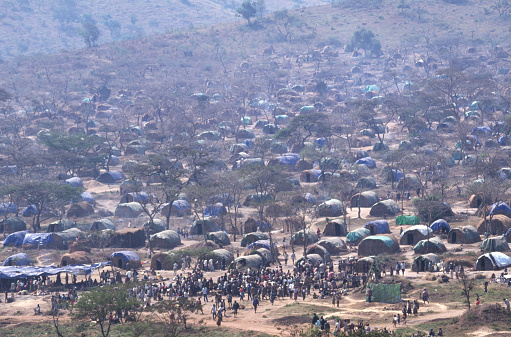
* Thumbnail photo: Camp of Hutu Refugees in Tanzania (Liba Taylor / Getty Images)
** The views expressed in the columns are those of the author(s) and do not represent the views of IDE or the institutions to which the authors are attached.
©2026 Masaaki HIGASHIJIMA and Yujin WOO

This column is licensed under a Creative Commons Attribution 4.0 International license (CC BY 4.0). https://creativecommons.org/licenses/by/4.0/deed
Subscribe Stay updated with our latest columns!