

IDE Research Columns
Column
What Xi Jinping’s Speeches Tell about His Policy Agenda
Jaehwan LIM
December 2025
Abstract
Political power in China has become significantly centralized under Xi Jinping, yet little research has examined how Xi’s impressive consolidation of power has affected the country’s policy agenda. Our analysis of Xi’s speeches and activities (Lim, Ito, and Zhang 2024) reveals evident shifts in policy priorities from his first to his second term. The scope of top-level attention has narrowed, and the policymaking focus has become more tightly aligned with Xi’s personal agenda, indicating how the personalization of authority is reshaping China’s governance.
Relevant Literature: Politics and Policy in the Xi Jinping Era
In the autumn of 2022, the Xi Jinping administration began its third term. Since taking office as General Secretary of the Chinese Communist Party (CCP) in October 2012, Xi Jinping has systematically dismantled long-standing norms and practices that had governed power-sharing and interactions among the Party leadership. These changes have resulted in an unprecedented consolidation of personal power, earning him the moniker of “the most powerful leader since Mao Zedong.”
While the concentration of power in the hands of a single leader is not uncommon in authoritarian regimes, during the reform era, the CCP leadership sought to institutionalize collective decision-making and constrain personalist rule as a corrective to the excessive concentration of power under Mao. Against this historical backdrop, the abrupt “personalist turn” under Xi Jinping is a puzzle that merits close examination (Shirk 2018).
Scholars offer differing explanations for this conundrum. One view attributes this concentration of power to the party’s shared sense of crisis at the outset of Xi’s tenure, marked by factional conflict, corruption, and rising U.S.–China tensions (Shirk 2022). Another perspective emphasizes Xi’s unique rise, arguing that his appointment did not tie him to any specific patron or faction but reflected a broad elite consensus.
Regardless of why this power concentration emerged, its policy consequences remain underexplored. Studies note significant reforms to the policymaking process (Dickson 2021; Cabestan 2021), yet few examine how these institutional changes and centralized authority have shaped the substance of policy itself, apart from limited attention to changes in the frequency and timing of policy initiatives (Chan, Lam, and Chen 2021).
Given the current state of research—and Xi’s concerted efforts to consolidate power—we analyzed how the policy agenda has evolved under his administration. What type of agenda has Xi Jinping presented and pursued since coming to power? How has his agenda evolved? In this column, we introduce the data and methods used in our analysis and present our findings regarding these questions.
Data and Methodology
This study draws on Xi Jinping Xilie Zhongyao Jianghua Shujuku (“Xi-Database”), a collection of over 10,000 official documents—including speeches, reports, site visits, press conferences, and overseas trips—produced since Xi became general secretary. While the database contains state media propaganda, its scale and frequency also make it valuable for empirical analysis (Ito, Lim, and Zhang 2024).
We employ structural topic modeling (STM), an unsupervised machine learning method that extends topic modeling by incorporating document metadata (e.g., dates) (Roberts, Stewart, and Tingley 2013). STM identifies topics, which it defines as sets of co-occurring words, and estimates their prevalence across documents, enabling an analysis of how topics vary over time.
In our approach, the frequency and co-occurrence of specific terms in Xi’s speeches and writings act as indicators of his evolving policy priorities. For instance, the increase in frequency of words such as innovation, technology, and self-reliance during Xi’s second term signals a growing prioritization of industrial upgrading and technological autonomy. We systematically track these linguistic patterns, quantifying and visualizing shifts in the content and focus of Xi’s policy agenda.
Results: Policy Agenda in the Xi Jinping Era
First, our analysis identified 25 distinct policy agendas articulated by Xi over his first two terms. In STM, topic number selection is analyst-driven; we determined the optimal number of topics by evaluating topic quality across several metrics, including semantic coherence and exclusivity (see Lim, Ito, and Zhang 2024, Appendix). Put simply, Xi outlined approximately 25 distinct policy agenda items over the 10 years after he took office.
Second, as illustrated in Figure 1, we observed notable shifts in the agenda between Xi’s first (2012–2017) and second terms (2017–2022). The figure shows changes in topic prevalence, with higher values on the horizontal axis indicating greater emphasis during the second term.
Topics that gained prominence include “COVID-19,” “China and Developing Countries,” “Socialism with Chinese Characteristics,” “Anti-Poverty,” and “Global Economy and Governance.” In contrast, the topics “China and Major Powers,” “Anticorruption and Cadre Management,” and “China and Asia-Pacific” declined in importance. These shifts indicate a diplomatic pivot from major-power relations to a broader engagement with developing countries, along with greater emphasis on global governance, ideology, and cultural narratives.
Domestically, ideological themes of socialism, party history, and propaganda became more visible during his second term. Meanwhile, Xi’s sustained attention to military modernization, the Belt and Road Initiative, nationalism, and Taiwan is evident across both terms.
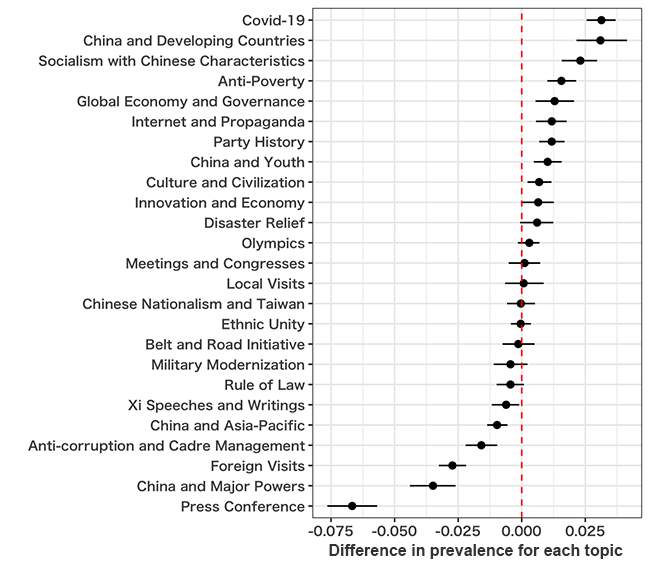
Figure 1. Changes in Policy Agenda Prevalence from Xi Jinping’s First (2012–2017) to Second Term (2017–2022)
Source: Lim, Ito, and Zhang (2024).
Notably, the agenda distribution in Xi’s second term suggests a notable shift in how he sought to strengthen intraparty unity and elite discipline. As illustrated in Figure 2, institutional measures—such as tightening anticorruption enforcement, enhancing legal supervision, and improving bureaucratic accountability—lost ground to ideological instruments in the second term, including campaigns to promote political loyalty, Marxist orthodoxy, and the study of “Xi Jinping Thought.”
This evolution signals a broader transformation in Xi’s governing approach, in which power consolidation has become increasingly grounded in ideological conformity rather than institutional constraint. In practical terms, regime legitimacy now depends less on procedural governance or institutional performance and more directly on Xi’s personal authority and ideological leadership.
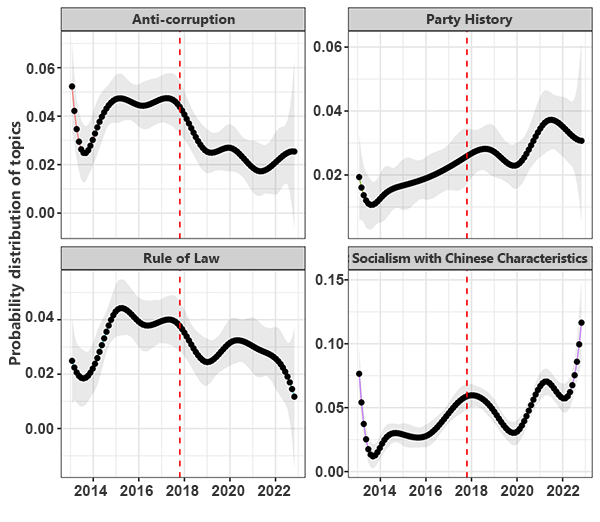
Figure 2. Temporal Evolution of Selected Policy Agendas under Xi Jinping (2012–2022)
Source: Lim, Ito, and Zhang (2024).
Each panel shows the probability distribution of topic prevalence over time, with shaded areas indicating 95% confidence intervals. The red dashed line marks the transition from Xi Jinping’s first (2012–2017) to his second term (2017–2022).
Avenues for Further Analysis
The relationship between Xi Jinping’s policy discourse and its implementation is a key issue. Assessing the extent to which his policy agenda—and the degree of his personal attention to each—is shared and implemented by the party-state bureaucracy, including local governments, would provide critical insights into the effectiveness of political consolidation under Xi.
Our study explores this through an analysis of the Belt and Road Initiative and the anticorruption campaign, finding a strong correlation between Xi’s discourse and its implementation in both cases. Nonetheless, notable discrepancies emerge, underscoring the dynamic and often inconsistent nature of the policy process.
Another area for future research is monitoring shifts in the vocabulary used to define policy agendas. While our analysis examines topic-level shifts, variation in language within the same topic could signal evolving priorities. Observing such lexical changes—even under consistent slogans—may provide clues about future policy directions.
References
- Cabestan, J. 2021. “China’s Foreign and Security Policy Institutions and Decision-Making Under Xi Jinping.” The British Journal of Politics and International Relations 23(2): 319-336. https://doi.org/10.1177/1369148120974881
- Chan, K. N., W. F. Lam, and S. W. Chen. 2021. “Elite Bargains and Policy Priorities in Authoritarian Regimes: Agenda Setting in China Under Xi Jinping and Hu Jintao.” Governance 34(3): 837-854. https://doi.org/10.1111/gove.12543
- Dickson, B. 2021. The Party and the People: Chinese Politics in the 21st Century. Princeton: Princeton University Press.
- Gentzkow, M., B. Kelly, and M. Taddy. 2019. “Text as Data.” Journal of Economic Literature 57(3): 535-574. https://doi.org/10.1257/jel.20181020
- Grimmer, J., and B. M. Stewart. 2013. “Text as Data: The Promise and Pitfalls of Automatic Content Analysis Methods for Political Texts.” Political Analysis 21(3): 267–297. https://doi.org/10.1093/pan/mps028.
- Ito, A., J. Lim, and H. Zhang. 2024. “Xi Jinping's Important Speeches as Data.” Asia-Pacific Review 31(2): 13-49. https://doi.org/10.1080/13439006.2024.2398371
- Lim, J., A. Ito, and H. Zhang. 2024. “Uncovering Xi Jinping’s Policy Agenda: Text as Data Approach.” The Developing Economies 63(1): 9-46. https://doi.org/10.1111/deve.12418
- Shih, Victor C. 2022. Coalitions of the Weak: Elite Politics in China from Mao’s Strategem to the Rise of Xi. Cambridge: Cambridge University Press. https://doi.org/10.1017/9781009022859
- Shirk, S. 2018. “China in Xi’s ‘New Era’: The Return to Personalistic Rule.” Journal of Democracy 29(2): 22-36. https://dx.doi.org/10.1353/jod.2018.0022
- Shirk, S. 2022. Overreach: How China Derailed Its Peaceful Rise. Oxford: Oxford University Press. https://doi.org/10.1093/oso/9780190068516.001.0001
Author's Profile
Jaehwan Lim is a Professor of International Politics at Aoyama Gakuin University (Ph.D. in law). His research focuses on comparative authoritarianism, with particular attention to Chinese political economy. His work has been published in outlets such as The China Quarterly, International Economics, China Economic Review, Journal of Contemporary China and The Pacific Review, among others.
* Thumbnail image: The Great Hall of the People (Sapphire / Getty Images)
** The views expressed in the columns are those of the author(s) and do not represent the views of IDE or the institutions to which the authors are attached.
©2025 Jaehwan LIM

This column is licensed under a Creative Commons Attribution 4.0 International license (CC BY 4.0). https://creativecommons.org/licenses/by/4.0/deed