


eBook
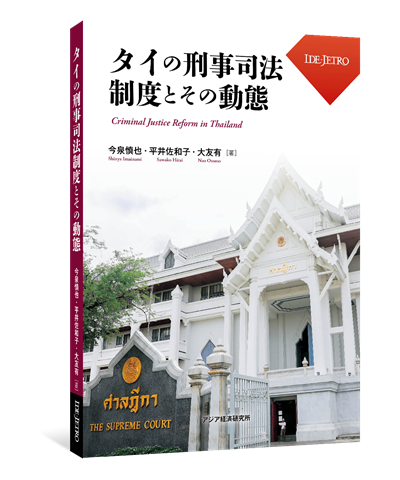

Criminal Justice Reform in Thailand (in Japanese)
Authors/Editors
Shinya Imaizumi, Sawako Hirai, Nao Ohtomo
Publication date
March 2026
ISBN
978-4-258-04677-5
Download eBook for free
Available in EPUB and PDF format for full book. EPUB files can be opened in eBook readers.
Buy the print-on-demand book
About this book
About this book
The development of Thailand’s modern judiciary began in the late nineteenth century, yet contemporary judicial institutions have been profoundly shaped by the wave of institutional reforms that accompanied the period of democratization in the 1990s. In recent years, however, Thailand has witnessed marked “democratic backsliding,” exemplified by the successful military coups of 2006 and 2014 and the subsequent restoration of military rule. Judicial decision-making has increasingly been influenced by political processes, and the nature and operation of criminal justice have themselves become matters of political contention.
This volume presents the outcomes of the research project “Criminal Justice Reform in Thailand,” conducted by the Institute of Developing Economies during fiscal years 2023–2024. Drawing on several rounds of field research in Thailand, the study incorporates interviews with criminal law scholars as well as officials and representatives from the Ministry of Justice, the courts, the Office of the Attorney General, the Lawyers Council of Thailand, and the Thailand Institute of Justice (TIJ). Based on these sources, the volume examines the objectives pursued by criminal justice reform in Thailand and the changes these reforms have brought about, as well as the distinctive features and challenges that characterize the current operation of the criminal justice system. While the analysis is grounded primarily in criminal law scholarship, it also incorporates approaches from area studies in order to illuminate aspects of the actual functioning of Thailand’s criminal justice system.
Contents
Preface
Introduction
Author: Shinya Imaizumi
Chapter 1 Thai Criminal Justice Reform: An Overview
Author: Shinya Imaizumi
Chapter 2 Organizational Reform in Thai Criminal Justice
Author: Shinya Imaizumi
Chapter 3 The Protection of Women and Children under Criminal Justice in Thailand
Author: Sawako Hirai
Chapter 4 Juvenile Justice in Thailand
Author: Sawako Hirai
Chapter 5 Enactment of the Drug Code and Rehabilitation of Addicts in Thailand
Author: Nao Ohtomo
Chapter 6 Development of Anti-Corruption Laws and Institutions in Thailand
Author: Shinya Imaizumi
Preface
Preface
This volume examines the challenges confronting Thailand’s criminal justice system and the various responses that have been explored in addressing them. More specifically, it seeks to clarify the characteristics and realities of Thai criminal justice through a review of criminal justice reforms implemented since the 1990s. In undertaking this analysis, the volume does not merely explain individual institutions and legal frameworks; rather, it places particular emphasis on identifying long-term trends in the evolution of Thailand’s criminal justice system. In an era in which the latest information on foreign countries can be accessed readily and instantly via the internet, information that illuminates the historical background of reforms and longer-term developments has become all the more valuable.
During the 1990s, Thailand experienced significant advances in democratization and political reform movements. Institutional reforms progressed across various sectors, catalyzed in part by the promulgation of a new constitution. Criminal justice was among the fields in which far-reaching reforms were undertaken. These included, for example, institutional changes aimed at enhancing the independence of judicial institutions and legislative measures designed to strengthen the protection of human rights within criminal justice processes. For this reason, the present volume takes the 1990s as its starting point for analysis.
In recent years, however, Thailand has experienced marked “democratic backsliding,” marked by the successful military coups of 2006 and 2014 and the subsequent restoration of military rule. Amid deepening domestic political polarization and increasing military involvement in politics, concerns have grown regarding the political use of the judiciary and the violation of human rights within criminal justice processes. At the same time, changes in the socio-economic environment and advances in technology have generated new forms of crime—such as those committed via the internet—prompting the enactment of new legislation aimed at addressing these challenges. Yet such measures also pose risks to citizens’ freedom of expression.
Conversely, even under military rule, the rhetoric of “national reform” has been strongly emphasized, and legislative efforts aimed at improving human rights protections within criminal justice and ensuring the proper administration of criminal procedures have continued with persistence. The coexistence of developments that appear to move in opposing directions may be regarded as a defining feature of Thailand’s criminal justice system in recent years.
This volume is the outcome of the research project “Criminal Justice Reform in Thailand,” conducted by the Institute of Developing Economies during fiscal years 2023–2024. The project involved several rounds of fieldwork in Thailand and included interviews with criminal law scholars as well as representatives from the Ministry of Justice, the courts, the Office of the Attorney General, the Lawyers Council of Thailand, and the TIJ, among others. While it is not possible to list here the names of all those who kindly agreed to be interviewed, as editor I would like to express my sincere gratitude to all the interviewees for their cooperation. In particular, Professor Narong Jaiharn and former Associate Professor Pisawat Sukonthapan of the Faculty of Law at Thammasat University, as well as Professor Kanaphon Jaihorm of the Faculty of Law at Chulalongkorn University, generously granted us numerous opportunities for interviews and provided invaluable advice on the direction of our research. We would like to note here our profound appreciation for their support.
When the term “judicial reform” is mentioned, many Thai people are likely to recall the modernization of the legal system initiated in the late nineteenth century under King Chulalongkorn (Rama V). As in Japan, Thailand—then known as Siam—was never colonized by Western powers. In order to abolish extraterritorial consular jurisdiction established under unequal treaties, the country undertook extensive legal reforms with the assistance of foreign legal advisers. This historical process is widely known. Among these advisers, alongside figures from Belgium, the United Kingdom, France, and the United States, was one Japanese individual: Masao Tokichi. Masao resided in Siam from 1898 to 1913 and was deeply involved in drafting the country’s penal code. His own writings note that the Japanese Penal Code of the time was consulted during the drafting process.
Although it is often said that traces of Japanese legal influence remain in the current Thai Penal Code, the extent and nature of this influence have not been sufficiently clarified in previous research. It is our hope that this volume will shed light on certain aspects of contemporary developments in Thai criminal law and, at the same time, contribute to further comparative research between the legal systems of Japan and Thailand.
March 2026
Authors