

Reports
International Symposium
The Trilemma of Decarbonization Development in the Asia-Pacific: A Policy Dialogue toward Integrated Solutions for Environment, Economy, and Equity
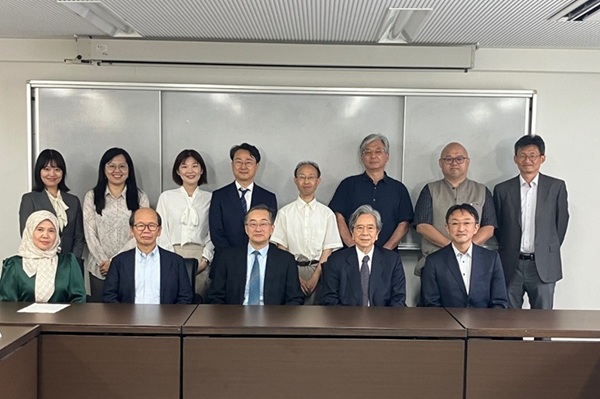
On 10 August 2026, the Institute of Developing Economies, Japan External Trade Organization (IDE-JETRO), Taiwan-Asia Exchange Foundation (TAEF), and Institute for Advanced Studies on Asia, The University of Tokyo (IASA) cohosted an international symposium titled “The Trilemma of Decarbonization Development in the Asia-Pacific: A Policy Dialogue toward Integrated Solutions for Environment, Economy, and Equity”. This page provides summaries of the discussions and presentations delivered during the symposium.
©IDE-JETRO
Overview of the Symposium
Date and time: August 10, 2026 (Monday), 13:30–17:35(JST)
Organizers:
Institute of Developing Economies, Japan External Trade Organization (IDE-JETRO)
Taiwan-Asia Exchange Foundation (TAEF)
Institute for Advanced Studies on Asia, The University of Tokyo (IASA)
Venue: Conference Room (3F), Institute for Advanced Studies on Asia, The University of Tokyo
Program
| Time | Agenda |
|---|---|
| Moderator: Dr. Alan H. Yang(Taiwan-Asia Exchange Foundation, Executive director) | |
| 13:30-13:40 |
Opening remarks
|
| 13:40-13:50 |
Purpose and overview
|
| 13:50-14:10 |
Keynote Speech: Balancing Decarbonization and Industrial Development in Malaysia
|
| 14:10-14:30 |
Keynote Speech: Decarbonization Policies and Democratic Governance in Taiwan
|
| 14:30-14:50 |
Keynote Speech: Decarbonization Development and the Trilemma in Indonesia
|
| 14:50-15:20 |
Panel discussion・Q&A
Moderator
Panelists
|
| 15:20-15:40 | Coffee break |
| Moderator: Dr. Fangting Cheng (IDE-JETRO, Inter-disciplinary Research Center, Senior Research Fellow) | |
| 15:40-16:00 |
Presentation: Green Infrastructure and Decarbonization Technologies in Sarawak, Malaysia
|
| 16:00-16:20 |
Presentation: Decarbonization and Social Transformation: Social Responses and Acceptance in Taiwan
|
| 16:20-16:40 |
Presentation: Decarbonization and Economic Development in the Global South
|
| 16:40-17:10 |
Panel discussion
Moderator
Panelists
|
| 17:10-17:30 |
Q&A
Moderator
|
| 17:30-17:35 |
Closing remarks
|
Overall Summary
Countries and regions are stepping up efforts to address climate change. At the same time, they must balance multiple policy objectives, including stable and affordable energy supplies, industrial competitiveness, employment, equitable energy access, and resilience to geopolitical and supply chain risks. Recent developments, such as Russia’s invasion of Ukraine, tensions in the Middle East, and the rapid growth of AI-related industries, have made it increasingly difficult to separate decarbonization from energy security.
Against this backdrop, the symposium explored decarbonization in the Asia-Pacific region as a “trilemma” involving environmental sustainability, economic growth, and social equity, rather than simply a matter of technological transition or emissions reduction. Through keynote speeches, presentations, panel discussions, and Q&A sessions, participants examined cases ranging from resource-rich Global South countries such as Malaysia and Indonesia to energy import-dependent economies including Japan and Taiwan. The discussions explored institutional, technological, industrial, and societal dimensions of the challenge, with a view to identifying policy pathways toward a balanced and sustainable energy transition.
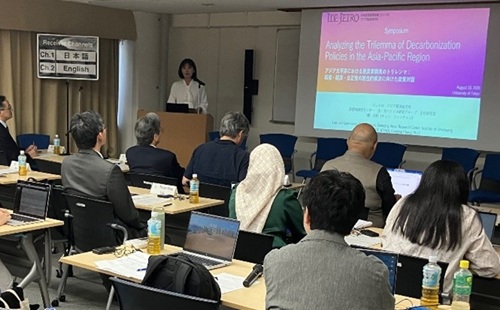
Dr. Fangting Cheng ©IDE-JETRO
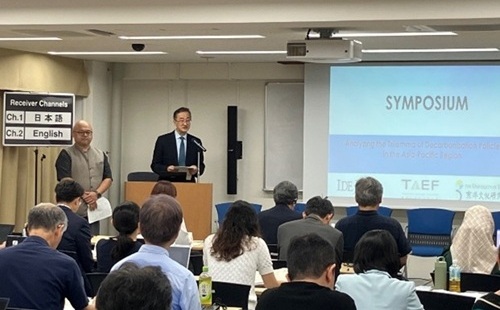
Dr. Fukunari Kimura
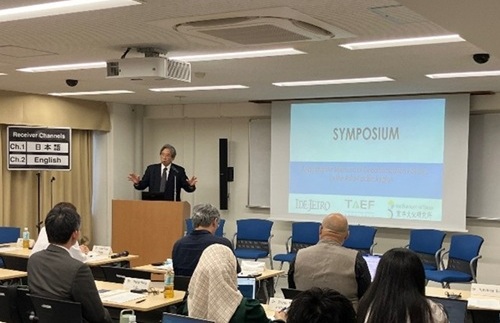
Dr. H.H. Michael Hsiao©IDE-JETRO
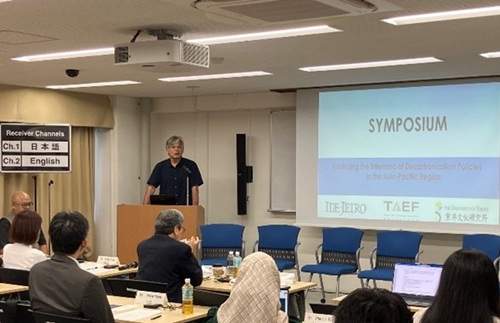
Dr. Shigeto Sonoda ©IDE-JETRO
Highlights of the discussion
The first half of the symposium focused on experiences from Global South countries, particularly Malaysia and Indonesia, alongside Taiwan as a more advanced economy in the region. Discussions examined the relationships among decarbonization, energy security, economic development, and social equity.
The opening keynote explored efforts in Malaysia to advance decarbonization while maintaining economic growth and industrial competitiveness. The presentation introduced ongoing initiatives in Bintulu, Sarawak, where decarbonization is being promoted through an industrial cluster approach centered on energy-intensive industries. At the same time, a number of implementation challenges were highlighted, including financing, human resource development, and technology localization. Particular attention was given to issues of social equity. While large corporations may be able to secure access to cleaner electricity by bearing additional costs, similar opportunities remain limited for many small and medium-sized enterprises. In addition, some areas within the state still face constraints in access to reliable electricity. The discussion therefore highlighted the importance of balancing decarbonization objectives with social justice considerations.
The keynote on Taiwan focused on democratic governance and public acceptance in the implementation of decarbonization policies. Speakers discussed the gap often observed between general support for low-carbon technologies and public acceptance of related infrastructure projects in local communities. The presentation also examined how perceptions of energy security influence policy preferences and energy choices.
The keynote on Indonesia addressed the implications of decarbonization policies for existing industries, particularly coal, as well as their impacts on land use, forests, and local communities. As the deployment of renewable energy technologies and battery systems increases demand for critical minerals, the presentation underscored the need to analyze climate and energy policies from a broader perspective that encompasses technological development, resource security, and land-use governance.
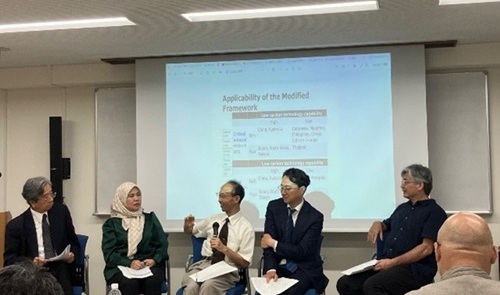
Building on these presentations, the panel discussion explored policy options for reconciling decarbonization and energy security while recognizing the diverse resource endowments and stages of economic development across countries and regions, including those in the Global South.
In the second half of the symposium, presentations and discussions focused on the technological, social, and industrial dimensions of implementing decarbonization strategies, with particular reference to Malaysia, Taiwan, and Japan. A presentation on Sarawak, Malaysia, highlighted developments in green infrastructure and decarbonization technologies. Echoing themes raised earlier in the symposium, the discussion emphasized that successful decarbonization requires not only the deployment of new technologies but also supporting infrastructure, skilled human resources, and appropriate financing mechanisms. The importance of collaboration among governments, businesses, universities, and other stakeholders was also emphasized.
The presentation on Taiwan examined public responses to and acceptance of decarbonization policies. While renewable energy and other low-carbon technologies generally receive broad public support, resistance often emerges when facilities are proposed in local communities. This finding suggests that support for decarbonization policies does not necessarily translate into acceptance of specific projects. The discussion also noted shifting public attitudes toward nuclear energy in recent years. Concerns relating to energy security, electricity supply stability, and broader security issues, including relations with China, may be influencing energy preferences. These discussions demonstrated that decarbonization is not only a technological and economic challenge but also a social one that requires effective communication and consensus-building with local communities.
From a broader international perspective, including Japan, participants discussed the relationship between decarbonization and economic development from the standpoint of both public policy and corporate behavior. In particular, the rapid expansion of AI and the semiconductor industry is driving growth in electricity demand, raising important questions about how to advance decarbonization while maintaining industrial competitiveness and ensuring stable energy supplies. Participants also noted that corporate decarbonization efforts are increasingly shaped not only by domestic policies but also by global supply chains and international environmental regulations. This underscores the importance of considering policy developments and business responses in an integrated manner.
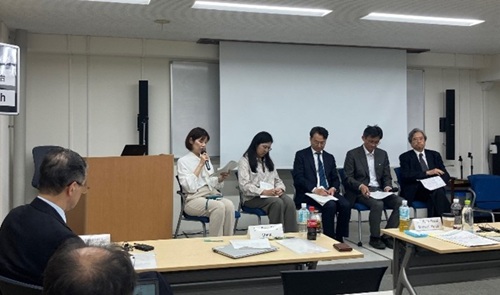
The subsequent panel discussion and Q&A session generated lively debate on a number of cross-cutting issues. Participants emphasized that energy security and decarbonization should not be viewed as competing objectives, but rather as mutually reinforcing goals that must be pursued simultaneously. The discussion also highlighted the importance of determining how the costs and benefits of the energy transition should be distributed across society and how public understanding and local acceptance can be secured.
Although countries and regions face different circumstances, whether energy-import-dependent economies such as Japan and Taiwan or resource-rich countries such as Malaysia and Indonesia, participants recognized a shared challenge: achieving industrial development, stable energy supplies, decarbonization, and social equity at the same time. The symposium concluded with a reaffirmation of the importance of continued comparative research and policy dialogue to explore pathways toward a pragmatic and equitable energy transition in the Asia-Pacific region.
©IDE-JETRO
©IDE-JETRO
Contact
Research Development Division
Institute of Developing Economies, Japan External Trade Organization (IDE-JETRO)
Tel: +81 (0)43-299-9667 Fax:043-299-9731
E-mail: R_promo2