

eBook
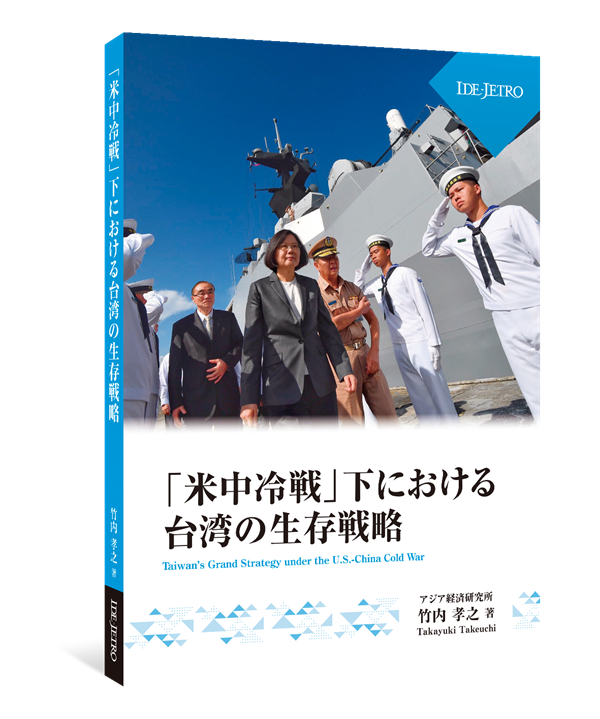

Taiwan’s Grand Strategy under the U.S.-China Cold War (in Japanese)
Download eBook for free
Available in EPUB and PDF format for full book. EPUB files can be opened in eBook readers.
Buy the print-on-demand book
About this book
About this book
This book examines the survival strategy of Taiwan—a "small but strong country" that could potentially influence the power struggle between the United States and China. Informed by key lessons from past armed conflicts between Taiwan and China and military history, the coverage of this book extends from a small country's military strategy to resist a great power to Taiwan's national defense strategy that encompasses military technology and social factors (particularly population), and then to the country's "grand strategy" (national security policy) that comprehensively incorporates diplomatic and economic measures. Threats to Taiwan's survival come not only from China, but also potentially from the United States, an ally. China's objective may be the formation of a cooperation with Taiwan in maritime strategy, particularly in the South China Sea, as opposed to literal unification or annexation. Taiwan ss an "island state," can potentially exert its power to balance power between great powers. Even without overt action from Taiwan, China is wary of Taiwan's military power and political influence. For a small country, possessing power to threaten a large country is a double-edged sword. Taiwan should therefore continue to behave as a "small but strong country."
Contents
Preface
Introduction Taiwan's Survival Strategy and the Great Power Competition
Chapter 1 Taiwan's National Defense Strategy and the Skepticism against United States
Chapter 2 The Geopolitical Relationship between China and Taiwan
Chapter 3 Taiwan's National Security Strategy: How to Manage the Relation with the Untrustworthy Great Powers—United States and China
Chapter 4 The Taiwan Issue and Intensifying US-China Confrontations
Conclusion The Essence of the Taiwan Issue and Facts and Fiction about the "Taiwan Contingency"
Preface
Preface
The existence of small countries is often attributed to unique factors. Taiwan and China have been in a militarily adversarial relationship since the end of World War II. Taiwan has deterred the annexation by China, with advantageous geopolitical position as an "island state" and its world-class air force and missile capabilities. Since national power dictates war sustainability, a small country needs to avoid a protracted war and crisis. Armed forces in small countries require qualitative superiority in proficiency of personnel and technology to realize the porcupine strategy—punitive deterrence strategy accompanied by lethal counter-attack capabilities.
US-China confrontations intensify as the two countries exchange provocations related to the Taiwan issue, and there are concerns that such confrontations could escalate into the "Taiwan emergency" (i.e., a Chinese military invasion of Taiwan) or a direct military clash between the United States and China. However, China's intent is not war with Taiwan—a "small great power"—but the formation of a united front with Taiwan in the South China Sea. China uses intimidation to induce transition of administration in Taiwan.
US and Chinese militaries front in the South China Sea, where submarines of both sides engage in underwater "silent battles" involving tracking operations. Just as road rage induces accidents, aggressive operations of military vessels and aircrafts could entail a risk of accidental collision. Underwater "silent battles", however, rarely elicit strong emotions and cautions among civilian politicians and the public. Therefore, Taiwan as the front line of "the US-China Cold War" would enhance the United States' ability to contain China, in both military and economic aspects.
The United States needs the "front line" as the icon of US-China Cold War, while it does not desire the emergence of a strong Taiwan capable of defeating the Chinese military. The fact that the West offers Ukraine only limited assistance to resist the Russian invasion could prompt the skepticism in Taiwanese that the United States' "strategy of deterrence by denial" intents to station Taiwanese on the front line against China, only with "shields," while denying sufficient "spears" (i.e., fighter jets and missiles).
The Art of War by Sun Tzu states that if you know your enemy and know yourself, you will not be defeated in a hundred battles. This underscores that successful strategic planning requires reliable situational awareness. Small countries need understanding the vulnerabilities of great powers and their own strengths to resist great powers. A hostile great power needs to expose the small country's vulnerability and to conceal its own, however, cognitive warfare concerned with power of small states and great powers can be ineffective, because it is indisputable that a small country's national power is inherently constrained. A more effective cognitive warfare is a tactic of division that elicits mutual distrust by exploiting the friction of alliance between a small country and an allied great power.
The book discusses a wide range of topics (i.e., military, political, geopolitical, and socioeconomic issues) and covers a wide geographic sphere including the United States, China, Taiwan, and Hong Kon. The Taiwan issue offers a perspective for comprehensively reexamining the history of US-China relations, which will be the main topic in my future research project. While focusing on the post-war period, this book traces the origins of Taiwan-China relations back to the late Ming and early Qing dynasties. Broad-ranging discussions in this book are required to examine the fundamental principles and the grand strategy for a nation's survival. This approach enables the reader to identify contradictions and oversights in specialized analyses.
This book is the product of the research project titled "Taiwan's Survival Strategy under Great Power Competition between the United States and China," conducted at the Institute of Developing Economies (IDE) in FY 2023–24. Prior to this project, I conducted research on related topics. From July 2012 to June 2014, I was a visiting researcher at the Institute of Taiwan History, Academia Sinica (as an IDE overseas researcher), where I studied Taiwan's foreign policy ideology, particularly the foreign policy of the pro-China Kuomintang. The frictions over the Senkaku Islands between Japan and Taiwan brought me questions regarding the relationship between Taiwan's Ma Ying-jeou administration and China. However, I could not find the answers to these questions, because of lack of geopolitical perspective. I could not also realize that the South China Sea held the key to resolving the puzzles within Taiwan-China relations until I returned to Japan. However, I had been collecting literatures on the South China Sea issue since my time in Taiwan. I would like readers to understand that author’s opinions on South China Sea issue still include inferences based on circumstantial evidence.
Lastly, I would like to express my gratitude to Professor Wu Rwei-ren for facilitating my stay at Academia Sinica, to Mr. Yukihito Sato of the IDE for his insightful commentary, to the anonymous reviewers for providing helpful comments and to colleagues for supporting the research project and the publication of this book.
March 2026
Author