


eBook
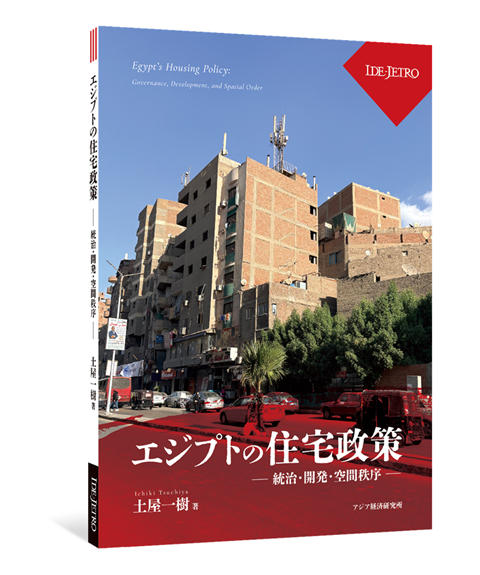

Egypt’s Housing Policy: Governance, Development, and Spatial Order (in Japanese)
Download eBook for free
Available in EPUB and PDF format for full book. EPUB files can be opened in eBook readers.
Buy the print-on-demand book
About this book
About this book
This book presents the findings of an individual research project titled “New City Development in Egypt,” conducted at the Institute of Developing Economies (IDE-JETRO) during the 2023–2024 fiscal year.
Since the late 1970s, Egypt has persistently pursued new city development in its desert areas, a trajectory most recently exemplified by the 2015 announcement of the New Administrative Capital (NAC). Despite the fact that many earlier projects have been widely regarded as failures due to low occupancy and inadequate services, successive administrations have continued to invest heavily in these urban ventures. Taking this paradox as its point of departure, the study reconsiders housing policy not merely as a matter of social welfare or urban planning, but as a form of state-making policy through which social order is constructed via population allocation and spatial reorganization.
The analysis is structured around three analytical perspectives: spatial governance, state–market relations, and development actors. Tracing the evolution of housing policy over seven decades, from the Nasser era to the present, the book highlights both continuity and transformation in the state’s approach to urban space. Particular attention is given to the current administration, under which the military has increasingly assumed an integrated role in land management, financing, and construction, emerging as a central governing hub for national development.
A defining feature of Egypt’s urban landscape is the coexistence of formally planned new cities and vast informal settlements that accommodate more than half of the urban population. By examining how the state governs these spaces through a logic of inclusion and exclusion, this book uses housing as an analytical lens to shed light on the evolving relationship between the state and society, as well as the mechanisms underpinning authoritarian rule in Egypt.
Contents
Preface
Photo Gallery
Introduction Governing through Housing: Egypt’s Housing Policy and the Making of Social Order
Chapter 1 Housing Policy under Nasser: State-Building and Social Integration
Chapter 2 Housing Policy under Sadat: Infitah and the Reconfiguration of Urban Space
Chapter 3 Housing Policy under Mubarak: Marketization and the Institutionalization of Urban Stratification
Chapter 4 Housing Policy under Sisi: Mega Projects and the Military-led State Capitalism
Chapter 5 Housing Policy as Spatial Governance: Urban Order and Techniques of Rule
Chapter 6 Housing Policy as State-Market Governance: Institutional Design, Financialization, and the Limits of Inclusion
Chapter 7 Housing Policy through Development Actors: The Military as a Governing Hub in Egypt’s Political Economy
Conclusion State Formation and the Reconfiguration of Governance through Housing Policy
Supplement Demographic Change and State Policy in Egypt: Linking Social Integration and Development Strategies
Preface
Preface
In March 2015, at the Egypt Economic Development Conference held in Sharm El-Sheikh, President Abdel-Fattah el-Sisi announced the plan to build a New Administrative Capital (NAC). Presented as a solution to Cairo’s chronic congestion, the project envisioned the construction of a vast new city in the desert and quickly drew international attention. Yet, viewed against the longer history of Egypt’s new urban development, the announcement raises a fundamental question. Since the late 1970s, Egypt has developed more than twenty new towns, many of which have failed to reach their planned population levels and have come to be regarded as incomplete or failed projects. Why, then, did the Sisi administration once again embark on such an ambitious “desert dream”? This question forms the starting point of this book.
This volume is based on the findings of an individual research project conducted during the 2023–2024 fiscal year at the Institute of Developing Economies, Japan External Trade Organization (IDE-JETRO), entitled “New Urban Development in Egypt.” In the Egyptian context, housing has never been merely a matter of physical shelter. Across successive regimes, it has served as a key instrument through which political authority has been legitimized and social order organized. By examining housing policy from the Nasser era to the present, this book seeks to reinterpret it not simply as social or urban policy, but as a policy domain through which the state itself has been shaped and reproduced.
The analysis is organized around three interrelated perspectives: spatial governance, state–market relations, and development actors. First, the book explores how housing policy has functioned as a technique of spatial governance, reshaping urban space and directing population distribution in ways that enhance governability. The New Administrative Capital, for example, has functioned not only as an urban development project but also as a means to separating administrative functions from sites of political contention and to make state authority more visible.
Second, the book examines the transformation of the state from a direct provider of housing into a designer of housing markets. Through land allocation, housing finance, and regulatory frameworks, the government has constructed what can be described as an institutionally shaped market. These mechanisms have filtered access to housing and, in doing so, have contributed to the consolidation of social and spatial inequalities.
Third, the book analyzes shifts in the actors responsible for housing policy, with particular attention to the role of the military under the Sisi administration. Far from being limited to construction, the military has become deeply involved in land management, financing, regulation, and the ownership of development entities. In this capacity, it has emerged as a central governing hub, exercising decisive influence over large-scale housing and urban development projects.
A defining feature of Egypt’s housing landscape is the coexistence of formal new towns and extensive informal settlements that accommodate more than half of the urban population. While informal housing is officially classified as illegal, it has long been tolerated in practice, with the state intervening selectively in order to contain social unrest. This form of dual governance—combining exclusion with partial inclusion—has helped sustain authoritarian rule while simultaneously reproducing deep social divisions. Understanding this paradox is essential for grasping the political logic underlying housing policy in Egypt.
This book is intended primarily for scholars of Middle Eastern studies, political economy, urban studies, and development studies, but it may also interest policymakers and practitioners concerned with housing and urban governance. By focusing on housing as both a basic social necessity and a tool of governance, the book offers insight into how states seek to shape society through everyday policy domains.
The author benefited greatly from comments and suggestions provided by anonymous internal reviewers, research committees, and editorial staff at the IDE. The book also owes much to the individuals in Egypt who shared their experiences during fieldwork, whether amid the bustle of Cairo or in the quiet spaces of new cities. The contrast between their aspirations for decent housing and the grand visions articulated by the state lies at the heart of this study. It is the author’s hope that this book will serve as a useful reference for those seeking to understand governance in Egypt through the lens of housing policy.
Ichiki Tsuchiya
IDE-JETRO
January 2026