

East Asia Beyond the Global Economic Crisis(Summary / Closing Remarks)
December 1, 2009, 13:00 - 17:40
Grand Prince Hotel Akasaka, Tokyo
>>Event Guide/Program
Organized by: Japan External Trade Organization (JETRO), Economic Research Institute for ASEAN and East Asia (ERIA)
Supported by: ASEAN Secretariat, Ministry of Economy, Trade and Industry, The Yomiuri Shimbun
Opening Addresses / Keynote speech | Panel Discussion(1) | Panel Discussion(2) |/ Summary / Closing Remarks
Summary
Mr. Hidetoshi Nishimura, Executive Director, ERIA
I was deeply impressed by Prime Minister Hatoyama’s strong resolve to pursue an East Asian community. ERIA indeed intends to serve to facilitate the concept of an East Asian community. Dr. Surin Pitsuwan, Secretary-General of ASEAN also expressed his support for the concept, commenting on the important role ERIA should play.
The discussions at this symposium have been based on the recognition that Asia’s economic structure, which has long relied on the U.S., “must undergo a dramatic transformation because the global imbalances are difficult to rectify.” Based on this recognition, a view has been presented that “intra-regional markets should be expanded and each domestic market should be opened in order to achieve growth while redressing export-import imbalances” and that “domestic enterprises should play a greater role in this process.” International economic gaps were also discussed. These discussions have been meaningful as a kickoff for debates toward building the proposed East Asian community.
ERIA, in cooperation with research institutions from 16 countries of East Asia, has made policy recommendations for East Asian economic integration by way of dialogues with researchers, economic circles and policy leaders, as we did in today’s symposium. Thanks to your efforts the role of ERIA is becoming increasingly recognized in the region. At the ASEAN Summit and the East Asia Summit in October 2009, the Chairman’s statement expressed strong expectations toward ERIA. In addition, Prime Minister Yukio Hatoyama, Prime Minister Abhisit Vejjajiva of Thailand, Prime Minister Wen Jinbao of China and Prime Minister Hun Sen of Cambodia mentioned ERIA in their speeches, while Prime Minister of India Dr. Manmohan Singh made a commitment for a contribution of 1 million U.S. dollars from India to ERIA over a period of ten years. Australian Trade Minister Simon Crean also announced at the APEC Ministerial Meeting in November this year that Australia will contribute 1 million Australian dollars to ERIA.
In October, the Governing Board of ERIA issued a statement that “the ERIA Governing Board members reiterated their common resolve to realize an East Asian community as a long-term goal” and “also expressed their expectation for ERIA to contribute to community building in East Asia as the intellectual focal point of the region and, in particular, to support ASEAN’s role.” ERIA will continue to contribute to the realization of an East Asian community through concrete policy proposals, and we ask for your continued guidance and cooperation.
Handouts | Photo
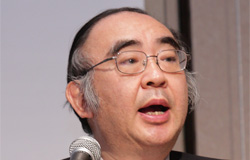
Mr. Hidetoshi Nishimura, Executive Director, ERIA
Closing Remarks
Mr. Yasuo Hayashi, Chairman and CEO, JETRO
First, I would like to express my sincere gratitude to Prime Minister Hatoyama, who in his opening remarks made reference to the significance of ERIA and this symposium. I would also like to thank our keynote speakers and panelists, who offered many insightful and inspiring views, as well as all of you for joining us today.
It is no exaggeration to say that the Japanese economy shares its fate with the rest of Asia, and today’s discussions indicated that the growth of this region continues to attract global attention.
But as we heard today, many challenges still remain for Asia to achieve sustainable development. Some of these include: the need for systems and infrastructure that facilitate the free movement of people, goods, capital and technology; overcoming poverty; reducing intra-regional economic disparities; and also the need for innovation. Japan is expected to do its part in overcoming these challenges, and also exert leadership towards “open” regional integration and add to East Asia’s economic development, through the activities of Japanese companies.
JETRO, chiefly through IDE, will continue to cooperate with and support the activities of ERIA, which serves as an impetus for East Asian economic integration.
To conclude my remarks, I wish you all good health and prosperity. Thank you.
Handouts | Photo
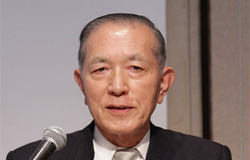
Mr. Yasuo Hayashi, Chairman and CEO, JETRO
Opening Addresses / Keynote speech | Panel Discussion(1) | Panel Discussion(2) |/ Summary / Closing Remarks