

East Asia Beyond the Global Economic Crisis (Panel Discussion2)
December 1, 2009, 13:00 - 17:40
Grand Prince Hotel Akasaka, Tokyo
>>Event Guide/Program
Organized by: Japan External Trade Organization (JETRO), Economic Research Institute for ASEAN and East Asia (ERIA)
Supported by: ASEAN Secretariat, Ministry of Economy, Trade and Industry, The Yomiuri Shimbun
Opening Addresses / Keynote speech | Panel Discussion(1) | Panel Discussion(2) | Summary / Closing Remarks
Panel Discussion 2: "Enhancing East Asia’s Role in the Global Economy"
Dr. Yin Xingmin, Professor, Fudan University
In 2009, the Chinese economy is heading for a strong recovery supported by industrialization. Industrialization remains the biggest driving force of China’s economic growth.
However, the content of industrialization appears to have changed. First, the major driving force of economic growth is shifting to heavy industries. In contrast to the 9.0% growth registered in light manufacturing output for January-October 2009, heavy industry output grew at a pace of 9.6%. The production of steel and aluminum registered a robust recovery supported by strong domestic demand such as infrastructure investment.
Further, companies make different contributions to economic growth depending on their form of ownership. While private sector and shareholding companies maintained a high growth rate in the January-October period of 2009, foreign-funded firms and state-owned enterprises experienced decelerated growth. Foreign-funded firms, among others, were greatly affected by the slower-than-expected export recovery.
In the meantime, reflecting the strong recovery of domestic demand, the production of non-export-oriented industries registered robust growth. Retail sales of consumer goods grew 15.1% for the previous 9 months over 2009. The supply of electricity also rose by 3.2%. Vehicle sales breached the 10-million barrier for the first time with 10.9 million automobiles sold in the first ten months of 2009. Labor-intensive textiles and apparel products and IT products, which have led growth in the past, experienced decelerated growth due to the slow recovery of exports, whereas heavy industries accelerated their growth with support from growing investment with the backing of the government.
Finally, let us review the future of the East Asian economy. If China’s economic growth continues into the future, it will create rising demand through higher imports. In order to link up the overall East Asian market including China, each country needs to further lower trade barriers. Also for the sake of the growth of East Asia’s economy, Asian production chains need to be developed by capitalizing on the strength of each country in the region. To this end, infrastructure should be improved throughout the region. When East Asia is in a position to take the lead in the world economy, we will be witnessing the emergence of a multi-polar world. Its realization will entail many challenges, but it can be achieved through cooperation among all the countries in the region.

Dr. Yin Xingmin, Professor, Fudan University
Dr. Amit Bhaduri, Professor Emeritus, Jawaharlal Nehru University
Globalization is an ongoing process and our connection with it must be strategic. Given the uncertainty about the recovery of the U.S. market, foreign demand (export)-led growth may no longer be viable and greater importance needs to be given to domestic markets. In this presentation, I will focus on trade and investment in relation to domestic market.
In trade, there is a “dangerous obsession” that higher labor productivity and lower real wages are necessary to enhance international competitiveness. This is undesirable. It is important to achieve economic growth that leads to more equality by treating labor productivity as a source of growth in domestic output and employment rather than viewing it as linked to international cost competitiveness.
In investment, a “race to the bottom” to attract FDI by way of tax exemptions and wage repression should be avoided. Instead, a “rise to the top” should be introduced, with FDI being attracted through better infrastructure, skilled labor and less corruption in administration. Efforts should also be made to expand domestic markets through wage-led and profit-led policies (for workers and enterprises, respectively) with greater emphasis on the former to include ‘social wage’ based on social welfare measures.
Focusing on the domestic market means that GDP growth becomes the outcome of employment growth. What is taking place in India and China is the opposite. For example, in India the high economic growth has not resulted in an expansion of domestic employment. It is important to increase demand in the domestic market by promoting employment and to achieve balance without relying too heavily on external markets.
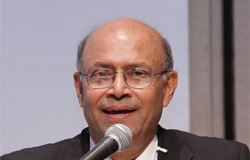
Dr. Amit Bhaduri,
Professor Emeritus, Jawaharlal Nehru University
Dr. Vedi Renandi Hadiz
Associate Professor, National University of Singapore
The impact of the world economic crisis on Indonesia has been small in comparison with the Asian economic crisis of 1997-1998. The country has managed to maintain positive economic growth and political stability. Soeharto was deposed as a result of the Asian economic crisis, but Susilo Bambang Yudhoyono was recently overwhelmingly reelected as president. However, the country’s underlying problems remain unchanged. What needs to be questioned in this context is how East Asian regional integration will help solve the problems Indonesia faces.
One of the fundamental challenges is poverty. In the background lie the problems of unemployment and underemployment. Due to the lack of social security, people find themselves in an extremely precarious situation. The world economic crisis has had an effect in that workers have been pushed out of the formal sector into the informal sector and in the form of lay-offs of workers overseas. The problems of inequality and poverty can potentially trigger social tension and conflicts, thus affecting regional stability.
Another major problem is corruption. In the past, it was estimated that corruption used up at least 20% of the national budget, and there is no reason to believe that the figure has shrunk. The foreign debt-to-GDP ratio has improved, but the foreign debt still amounts to about 80 billion U.S. dollars. Together with corruption, the funds allocated to pay back debt hamper the ability to improve social security and welfare.
What are the implications of regional integration vis-à-vis Indonesia? Would integration help improve the quality of life of the people, improve social welfare and increase overseas regional job opportunities? Regional integration should not just be about free trade and free movement of capital but also freer movement of labour, which could help alleviate Indonesia’s unemployment problem. But it is politically impossible for countries like Japan to accept surplus Indonesian labour. Some NGO activists question if regional integration dominated by the Tokyo-Beijing axis would be any different, for the Indonesian people, from globalization dominated by Washington.
In conjunction with the progress of regional integration, Indonesia’s development policy is being reassessed by critics. A reevaluation of the export-led growth strategy and a shift toward a strategy of emphasizing the domestic market by stimulating domestic demand and the elimination of poverty is called for. However, this does not mean abandoning the export-led strategy altogether. Rather, it entails a reevaluation of priorities. What needs to be asked is how East Asian regional integration will contribute to this reassessment and to improving the lives of ordinary Indonesians.

Dr. Vedi Renandi Hadiz,
Associate Professor, National University of Singapore
Dr. Miroslav Jovanovic
Lecturer, European Institute of the University of Geneva
After the credit crunch in 2007-2008, neo-protectionism resurged in the U.S and elsewhere in various types of “Buy domestic” campaigns and the excessive subsidies given to car manufacturers and banks. A superior response would have been closer and deeper regional integration and the convergence of regulations to stimulate productivity and innovation, provided that third parties were not discriminated against. The trend toward protectionism in the U.S. is a matter of wide concern.
Do ASEAN, along with China, Japan and Korea, intend to draw an economic line in the middle of the Pacific by way of regional integration? Pressure for an internal regional integration agreement works in favor of external liberalization as firms gain competitiveness thanks to reduced costs, specialization and innovation. The more the countries have regional trade agreements with their principal trading partners, the less they worry about the negative effects of integration and the more they can gain from the multilateral removal of overlapping rules of origin (ROO).
In today’s Asia, a variety of FTAs have been concluded, and multiple ROOs are intricately intertwined with one another. Reducing overlaps among ROOs and administrative costs would increase gains from trade. In this context, multilateral rules are a potential solution. If the Doha Round succeeds, RTAs will become irrelevant, whereas if it fails, they will be the second best solution. In the latter case, the ROO in the regional trade agreements should be as simple as possible, allowing relatively high external value content and minimizing compliance and administrative costs. As a bridge for the success of the Doha Round, it is desirable to include food and product safety and environmental sectors, e.g. scrapping tariffs on climate-friendly products and promoting “green” technologies.
The U.S. uses FTAs to reward its allies, whereas the EU is seeking an FTA with the ASEAN countries as a group. One future challenge for ASEAN is innovation. Services and energy need to be put on the agenda for future discussions in Asia.

Dr. Miroslav Jovanovic,
Lecturer, European Institute of the University of Geneva
Dr. Khoo Boo Teik
Executive Senior Research Fellow, Area Study Center,
IDE-JETRO
The financial crisis that swept North America and Europe in 2008–2009 has had enormous economic impacts on other regions of the world. In East Asia, a severe reduction in Western demand for manufactured exports has raised doubts over the sustainability of export-oriented industrialization that has for so long driven East Asian growth. Some analysts of East Asian political economy, looking for ways to moderate the region’s dependence on external consumption, are reassessing the region’s potential for consumption, and not just production, especially if China, by growth and policy, significantly raises its capacity to absorb regional manufacturing output.
Related to this is an interest in the pace and depth of regional economic integration as a route out of excessive export dependence on Western markets. Thus far, despite progress in regional integration, different obstacles stand in the way. For some, it is difficult to imagine Asian integration across many ideational variations, differences in identities and normative diversities. It also seems problematic to manage competing state concerns, including security issues; trade, investment and currency flows; and complementarities of industrial structures.
This presentation focuses on socio-economic inequalities that include vast material ranges, the persistence of severe poverty, and intra-regional gaps in income, wealth and well-being which form an underrated obstacle to regional integration. Thus, learning from East Asian political developments and other experiences of regional integration should lead to more concerted use of effective social policies to reduce poverty and inequality within the East Asian community.

Dr. Khoo Boo Teik,
Executive Senior Research Fellow, Area Study Center,
IDE-JETRO
Moderator:Dr. Syujiro Urata,
Senior Research Advisor to the Executive Director,
ERIA and Professor of Waseda University
Handouts | Photo

Dr. Syujiro Urata,
Senior Research Advisor to the Executive Director,
ERIA and Professor of Waseda University
Opening Addresses / Keynote speech | Panel Discussion(1) | Panel Discussion(2) | Summary / Closing Remarks