

East Asia Beyond the Global Economic Crisis (Panel Discussion1)
December 1, 2009, 13:00 - 17:40
Grand Prince Hotel Akasaka, Tokyo
>>Event Guide/Program
Organized by: Japan External Trade Organization (JETRO), Economic Research Institute for ASEAN and East Asia (ERIA)
Supported by: ASEAN Secretariat, Ministry of Economy, Trade and Industry, The Yomiuri Shimbun
Opening Addresses / Keynote speech | Panel Discussion(1) | Panel Discussion(2) | Summary / Closing Remarks
Panel Discussion1:"The Global Economic Crisis and East Asian Perspectives"
Dr. Ikuo Kuroiwa
Senior Research Fellow and Director-General,
Development Study Center, IDE-JETRO
The East Asian countries have achieved high economic growth by participating in production networks. However, in the current economic crisis, import demand from the developed countries, which constitute the region’s final users, declined sharply, and this had a major impact on East Asian countries through the production networks. Among other factors, triangular trade through China has grown sharply in recent years and as a result, China’s export trend vis-à-vis the developed countries now has a strong impact on the industries of its neighbors.
An analysis based on the Asian International Input-Output Table finds that approximately 20% of the impact of the economic crisis on the industries of Korea and Taiwan came from the triangular trade through China. In Japan, too, export dependency rose rapidly and triangular trade has grown significantly. On the other hand, China, while having a great effect on the other East Asian countries through triangular trade, is not vulnerable to shocks from other countries due to its huge import surplus in the intermediate goods trade.
The extent of the impact of triangular trade differs widely from industry to industry. The electrical and electronics industry, where there are developed production networks, and materials industries (metals, chemicals) and trade and transport services are vulnerable to the impacts of triangular trade, whereas automobile and other transport equipment are very little affected by triangular trade.
The current economic crisis has revealed the vulnerability of production networks. In the future, there is a need not only to expand production networks but to internally boost final demand within Asia.

Dr. Ikuo Kuroiwa,
Senior Research Fellow and Director-General,
Development Study Center, IDE-JETRO
Dr. Jong Nam Oh, Professor, Seoul National University
In the background of the current world economic crisis is the problem of international imbalances deriving from the continuation of the chronic current-account deficit of the United States and the current-account surplus of Asia and the emerging economies. The international imbalance originates from deep-rooted demand for U.S. dollars as the world’s reserve currency, China’s current-account surplus resulting from the undervaluation of the Chinese yuan against other foreign currencies, and the savings and current-account surplus of the emerging economies. The demand for U.S. dollar-denominated assets encouraged the low interest rate and development of various financial products in the United States, which appear to have been remote causes of the global economic crisis.
In June 2006, prior to the crisis, the IMF called for international coordination to rectify the international imbalances, presenting among other things a comprehensive strategy that included the encouragement of savings in the U.S., expansion of Asia’s internal demand and the introduction of more flexible exchange rates. Meanwhile, the market turmoil triggered by the U.S. sub-prime mortgage crisis shook the confidence of the world’s credit markets, leading to an environmental change and triggering fear that the weak growth and credit crunch in the U.S. would trigger a recession in the world economy. The G20 also discussed coordination to correct the international imbalances as means to cope with the world economic crisis, adopting this as a shared view.
The challenges of East Asia in this context include the stimulation of internal demand and the expansion of intra-regional trade as a means to rectify the international imbalances. Solving these problems will lead to a decline of Asia’s high dependency on the U.S. market. China must expand its private consumption, and the government needs to engage in developing a financial market that enables such consumption. Furthermore, adjusting the exchange rate to be in line with economic fundamentals will also serve to correct the international imbalances.
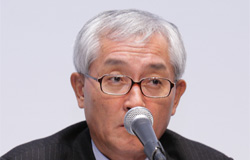
Dr. Jong Nam Oh, Professor, Seoul National University
Dr. Byron Gangnes, Associate Professor,
University of Hawaii
In the aftermath of the global financial crisis, the economic recovery of both Japan and the U.S. in 2009 has been weak. On the other hand, a number of Asian developing economies are well on the track toward recovery.
First, let us take a look at the U.S. economy. It appears that the U.S recession has ended. Both production and orders are rising. Overall economic growth is projected to be –2.5% for 2009 and +2.4% for 2010. As such, the U.S economy as a whole is heading toward recovery but it still faces challenges. First, in the labor market, jobs are still being lost, and this will likely continue for some time. The prospects for a rebound in consumption are poor. The value of assets held by households has declined significantly due to the financial shock, and this deleveraging is hampering consumer spending. It is hard to project a scenario for a robust recovery. One of the factors that supported the strong economy before the financial crisis was the housing boom, triggered partly by the issuing of mortgages to increasingly risky borrowers. Today this is considered excessive lending. In the government sector, budget balancing is a challenge. Given those circumstances, there is no clear scenario for a strong recovery.
On the other hand, many Asian developing economies are on a firm recovery path. In 2008, exports collapsed due to the shrinking of demand in Europe, the U.S and Asian countries. Asia’s exporting countries reacted to this by adjusting their production and drawing down inventories to meet the supply of goods. At present, they have gone through a full inventory cycle and production is increasing, driving the rebound. However, the financial crisis did not hit the Asian economies in a uniform manner. The deep recession in Europe and the U.S. led to a sharp decline of exports from the Asian countries. As such, the decline of exports due to the financial crisis had the most severe impact on the small export-dependent economies of South-East Asia. In contrast, South Asia was less affected, and China benefitted from aggressive government stimulus.
The future direction of the world economy’s recovery will be determined by fiscal and monetary policies. The rebound can be supported by appropriate government policy, but could be derailed by a premature removal of stimulus.

Dr. Byron Gangnes, Associate Professor,
University of Hawaii
Dr. Yoshihisa Inada, Professor, Konan University
Japan’s real GDP growth for July-September 2009 (first preliminary QE) is an annualized +4.8% from the previous quarter, posting positive growth for the second consecutive quarter. This is the highest growth rate since January-March 2007 (+5.7% compared to the previous quarter). Factoring in this July-September growth (first preliminary QE) and the new policies to be introduced, my projections for real GDP growth for FY2009, FY2010 and FY2011 are –2.3%, +1.4% and +2.0%, respectively. The contribution of private demand to the growth will improve from –2.3 percentage points in FY2009 to +0.5 percentage point in FY2010 and +1.6 percentage points in FY2011. As private non-residential investment will hit bottom in FY2010, private demand will become a factor boosting the economy. By contrast, public demand will become a dragging factor, with –0.1 percentage point in FY2011 from +0.1 percentage point in FY2010, as the policy effects are depleted. Net exports will make a positive 0.9 percentage point contribution in FY2010, but will fail to grow stronger, remaining at a contribution of +0.5 percentage point in FY2011. This is because there is little hope for a strong recovery of the European and the U.S. markets.
Real GDP in January-March 2009 dropped 8.4% from the peak of January-March 2008 (100). This is the largest decline of all the post-war recessions. Although the figure will improve to 97.8 in the Jan.-March 2012 quarter, the recovery will remain moderate and even after three years will not have returned to the peak level of the past. As a result, the Japanese economy will continue to suffer from large demand-supply gaps. As it takes time to narrow these gaps, the escape from deflation will take time.
The new government led by Prime Minister Hatoyama has cut part of the first supplementary budget for FY2009, and this will lead to a reduction of real GDP of the same fiscal year by 0.24% . The policy of the new government, based on the manifesto of the Democratic Party of Japan, will have little impact in FY2010, but will make an approximate 0.2% contribution to expanding consumption, and private consumption in particular. The policy of shifting “From Concrete to Human” will certainly have strong policy effects but its economic stimulus effect will be small, and a new strategy for domestic demand expansion will be required. Green industry is one promising sector. The sector can contribute not only to stimulating domestic demand but also external demand, especially in the Asian region.

Dr. Yoshihisa Inada, Professor, Konan University
Mr. Daisuke Hiratsuka
Senior Research Fellow and Director-General,
Research Planning Department, IDE-JETRO
Handouts | Photo

Mr. Daisuke Hiratsuka,
Senior Research Fellow and Director-General,
Research Planning Department, IDE-JETRO
Opening Addresses / Keynote speech | Panel Discussion(1) | Panel Discussion(2) | Summary / Closing Remarks