
China’s New Age: Towards Matured Society Structural Issues and Policy Options
January, 25, 2013, (Friday)
United Nations University U Thant International Conference Hall
>>Program:
Organizer:IDE-JETRO, The Asahi Shimbun Company
Keynote Speech1
Wenkui Zhang (Deputy Director, Enterprise Research Institute,
Development Research Center of the State Council)
China’s economic growth has been driven by the government’s role in the allocation of resources and the presence of the state sector, including state-owned enterprises. However, the importance of the state sector in the Chinese economy has been diminishing. Moreover, improving productivity in the non-state sector has become a major engine behind economic growth. Therefore, the Chinese government must revise resource-allocation policies that give priority to the state sector. Furthermore, China must encourage competition centered on small and medium-sized enterprises and new corporate entrants, with the view to shifting the Chinese economy to an innovation-driven growth track. Going forward, the Chinese government must reform its fiscal system, while implementing policies to improve local government functions, in order to enhance the provision of public goods such as healthcare and education.
China’s economic growth is currently at a turning point. There has been a large decrease in China’s latent growth potential. Until now, Chinese companies have generated profits through increased sales supported by the country’s rapid economic growth. With weaker prospects for top-line growth, however, there is a higher likelihood that large numbers of companies could become unprofitable. Before massive losses are produced, the Chinese government must start implementing further reforms of state-owned enterprises.
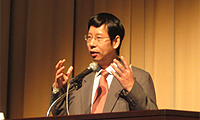
Wenkui Zhang
(Deputy Director, Enterprise Research Institute,
Development Research Center of the State Council)
Keynote Speech2
David Shambaugh (Professor, George Washington University)
The Xi Jinping administration is not reform oriented, based on its members. Most of the Politburo Standing Committee members are known to be conservative. However, there are many reformists among Politburo members. Compared with Li Keqiang, Xi Jinping still presents many uncertainties. That said, I believe that we should note the following points based on recent events. First, Xi Jinping has fought to end corruption. Second, judging by his attendance at an exhibition called the Road of Rejuvenation, Xi Jinping seems to have a strong affinity with nationalism. The Xi Jinping administration must tackle the following issues: transform the economic growth model, ease media controls, provide public goods, end corruption, and solve ethnic problems. As regards foreign relations, the administration faces no shortage of issues in terms of relations with the world’s major powers and neighboring countries. Another issue is that the international community does not have a favorable image of China. The new administration faces three main challenges in the course of embarking on reforms. First is the problem of dependency on the current economic path. Until now, China has succeeded with a labor-intensive economy. Going forward, it will need to build a knowledge-intensive economy, but this will be difficult to achieve under an authoritarian system of government. The next challenge is how to dispel the shadow cast by the Soviet era. Although liberalization is needed in all manner of fields, China is cautious about liberalization. Finally, China’s vested interests (the military, domestic public safety agencies, the conservative wing of the Communist Party, state-owned enterprises, etc.) are not enthusiastic about reforms that would change the status quo.

David Shambaugh
(Professor, George Washington University)
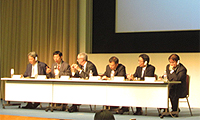
Panel Discussion
Moderator
Takashi Shiraishi (President, Institute of Developing Economies (IDE-JETRO))
Panelists
Ming Wang (Director, NGO Research Center, Tsinghua University)
Yasuo Onishi (Director-General, Inter-disciplinary Studies Center, Institute of Developing Economies (IDE-JETRO))
Norihiro Sasaki (Deputy Director, East Asian Studies Group, Area Studies Center, Institute of Developing Economies (IDE-JETRO))
Wenkui Zhang (Deputy Director, Enterprise Research Institute, Development Research Center of the State Council)
David Shambaugh (Professor, George Washington University)
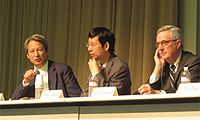
The panel discussion began with presentations of reports by Ming Wang, Director, NGO Research Center, Tsinghua University; Yasuo Onishi, Director-General, Inter-disciplinary Studies Center, IDE-JETRO ; and Norihiro Sasaki, Deputy Director, East Asian Studies Group, Area Studies Center, IDE-JETRO. Thereafter, they were joined by the two keynote speakers for a discussion on issues facing Chinese society, moderated by IDE-JETRO President Takashi Shiraishi.
(1) Ming Wang (Director, NGO Research Center, Tsinghua University)
In the past six years, NGOs have begun to take on a major role in central government policies. In fact, the 18th Party Congress made many references to NGOs. Before China’s reform and liberalization policy, the “state” was the primary concept. After this policy was implemented, the concept of “free markets” was born, followed by the emergence of the notion of “civil society.” The 18th Party Congress used the term “the modern NGO structure” for the first time. This suggests that a future vision for a civil society is materializing in China. China’s NGOs comprise three types of groups that are able to register with the Ministry of Civil Affairs (non-governmental bodies, foundations, non-profit organizations), and numerous other groups that are unable to register. The former consists of approximately 200,000 groups, whereas the latter is estimated at more than 2 million groups, although there are no accurate statistics. At present, structural reforms of personnel and public bodies that are government-affiliated organizations are under way. I believe that these groups will eventually become NGOs. Looking ahead, we should keep a close eye on whether or not a Chinese-style of corporatism will emerge in step with the expansion in NGOs and structural reforms in China.
(2) Yasuo Onishi (Director-General, Inter-disciplinary Studies Center, Institute of Developing Economies (IDE-JETRO)
China’s new administration is facing various issues, including the need to promote macro-economic stabilization and market reforms, achieve balanced economic development, and resolve structural inequality. The World Bank, together with Wenkui Zhang and other Chinese researchers, presented a prescription for addressing these issues last year, but implementation will be difficult given that vested interest groups are expected to oppose these measures. China’s rapid economic growth has started to reshape economic ties between Japan and China. Japan must show that it can be an important partner of China by pursuing a complementary relationship in line with changes taking place in the country.
(3) Norihiro Sasaki (Deputy Director, East Asian Studies Group, Area Studies Center, Institute of Developing Economies (IDE-JETRO))
Compared with his predecessors, Xi Jinping has made a more advantageous start. There are two reasons for this. The first reason is that Xi Jinping has not only become the General Secretary of the Communist Party of China, but has also assumed the post of Chairman of the Party’s Central Military Commission, and will become the President of China in March. This represents a consolidation of power. Next, the five members of the Politburo Standing Committee belonging to the Jiang Zemin faction will retire in five years. This means that this faction has run its course. Therefore, compared with his predecessors, Xi Jinping will be less influenced by the elders of the Communist Party. The Xi Jinping administration faces two main priorities. The first is reforms that will revise or privatize part of the government (mainly the issue of improving the living standards of the Chinese people) under the premise of preserving the framework of one-party rule. The other priority is reforms to the political structure that will challenge the framework of one-party rule. The former reforms will be relatively easy to implement because power has already been consolidated in Xi Jinping’s hands. In regard to the latter, it will be difficult to challenge one-party rule given that Xi Jinping himself is a General Secretary born of this framework.
(4) Wenkui Zhang (Deputy Director, Enterprise Research Institute, Development Research Center of the State Council)
I believe that China can achieve a stable society if it can maintain its economic growth rate (i.e. the central government can secure an adequate source of funding) and control the inflation problem. Things will become difficult once China’s rapid economic growth comes to a stop.
(5) David Shambaugh (Professor, George Washington University)
I fully agree with the notion that Xi Jinping has started out in a better position than Hu Jintao and Jiang Zemin. The reformists may appear five years from now, but the question is whether China can afford to wait five more years. China requires drastic political reforms immediately — reforms that will shake the very foundations of one-party rule. The six issues that I have presented should be addressed comprehensively. Success cannot be achieved through partial implementation. Initially, Xi Jinping should face tremendous opposition from within the system as he embarks on reforms. The modern Chinese political system reminds one of the Nationalist Party of China and the late-Qing Dynasty's government of the past. Resemblances with the past include growing social inequality, government corruption and the exodus of the middle and elite classes to overseas countries. China’s political structure is not a stable system, and presents huge problems.